Analisi esperta di The Worm-Eaten and Creased di Hans Bellmer
Genere: symbolic painting
Expert Analysis: "The Worm-Eaten and Creased" by Hans Bellmer
Hans Bellmer (1902–1975) was a German-born French surrealist whose work consistently challenged conventional representations of the body, desire, and decay. "The Worm-Eaten and Creased"—known as a symbolic painting—exemplifies his signature themes: the fragmentation and eroticization of the human form, the unsettling interplay between life and death, and the psychological undercurrents of repressed trauma. This piece holds particular significance within Bellmer’s oeuvre and the broader surrealist movement.
1. The Symbolic Language of Decay and Desire
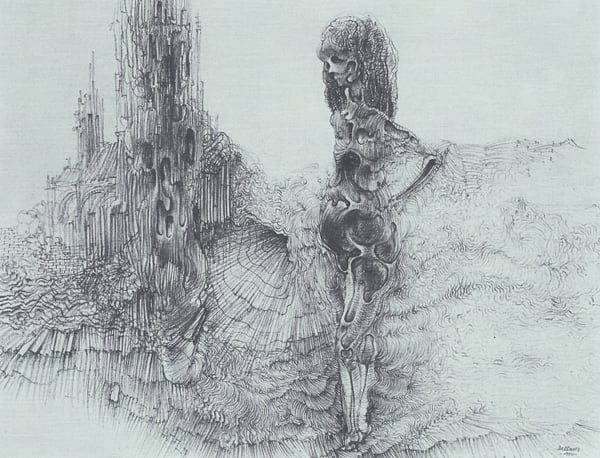
The title itself evokes a duality: “worm-eaten” suggests rot, impermanence, and the biological inevitability of decomposition, while “creased” implies manipulation, distortion, and the artificial marking of a surface. In Bellmer’s world, the body is never whole—it is a site of conflict. He famously constructed articulated dolls with interchangeable limbs, photographing and painting them in contorted, often violent positions. “The Worm-Eaten and Creased” likely continues this investigation: the body appears consumed from within or marked by time, yet remains a vessel for erotic tension. This aligns with surrealism’s fascination with the uncanny—the familiar made strange and disturbing.
2. Defying Conventional Beauty
Bellmer deliberately rejects classical ideals of the nude. Instead of harmony and proportion, he offers dismemberment, asymmetry, and the grotesque. Here, the “worm-eaten” quality may manifest as holes, lesions, or dissolving contours, while “creased” could appear as folded, layered, or crushed anatomy. This is not a passive subject but an active confrontation with the viewer’s expectations. The painting forces us to question where the boundaries of the body end—and where desire and disgust intertwine.
3. Psychological and Political Context
Bellmer created his most famous doll series in the 1930s as a direct response to the rise of Nazism and its cult of the “perfect” Aryan body. His deformed, manipulated figures are acts of rebellion against authoritarian ideals of purity and control. “The Worm-Eaten and Creased” continues that subversive tradition. The symbolic language of decay and creasing can be read as a refusal to conform: the body resists being a static, idealized object. Instead, it is a process—mutable, vulnerable, and defiant.
4. Significance Within Surrealism
While surrealists like Magritte and Dalí explored the dreamlike and the bizarre, Bellmer’s work is uniquely corporeal. He brings psychoanalysis (especially the theories of Jacques Lacan) to bear on the physical body, making the unconscious manifest through flesh. The symbolic painting genre allows him to condense multiple meanings into a single charged image: the worm (a phallic symbol, a creature of decay, a witness to the body’s afterlife) and the crease (a trace of manipulation, of time, of folding oneself into new configurations). This dense layering is why Bellmer remains a pivotal figure—his work forces us to see the body not as a given, but as a question.
Conclusion
“The Worm-Eaten and Creased” is significant because it embodies surrealism’s deepest concerns: the instability of identity, the eroticism of the abject, and the power of art to critique social norms through visceral shock. Bellmer transforms decay into a language of resistance, making the worm-eaten and creased not simply ugly, but profoundly meaningful.
Genere
Visivamente simili
20 opere con composizione e palette affini
The Woman at the Cathedral
Hans Bellmer
Liebe Tot und Teufel
Jürgen Bley
Untitled1
Nathan Judds
Untitled
Hans Bellmer
Untitled
Albin Brunovsky
Warning
Ivan Marchuk
Untitled
Hans Bellmer
Rebel
Wojciech Siudmak
Untitled
Zdzislaw Beksinski
Les etrangers
Wolfgang Paalen
Hesperis numbed sunset
Chicote CFC
Disintegrating Trench
Otto Dix
Cathedral
Darren Waterston
Fata Alaska
Wolfgang Paalen
Untitled
Zdzislaw Beksinski
Untitled
Zdzislaw Beksinski
WENN AUCH VON ANDERER SCHÖNHEIT
Richard Oelze
Clause of estimate selective
Chicote CFC
Parque dos Insultos
Marcelino Vespeira
Untitled
Zdzislaw Beksinski