Expertenanalyse zu Paul Gauguins The lemon picker
Stil: Cloisonnism · Genre: genre painting
Expert Analysis: "The Lemon Picker" (1890s) by Paul Gauguin
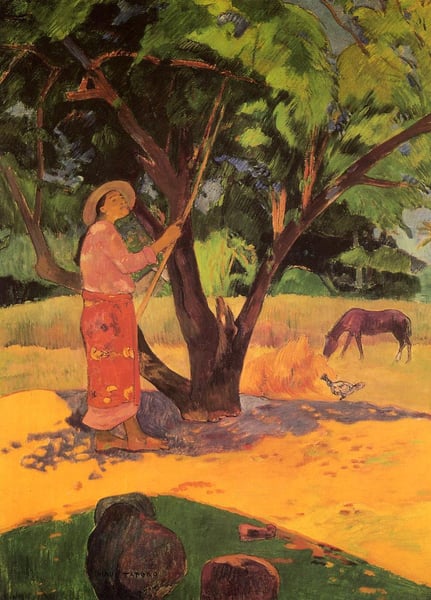
Style & Technique (Cloisonnism) Gauguin’s “The Lemon Picker” is a quintessential example of Cloisonnism, a Post-Impressionist style defined by bold, dark contours that enclose flat, unmodulated fields of pure color—much like stained glass or cloisonné enamel. In this work, the figure of the Tahitian woman is delineated with strong, sinuous outlines, while the lemon tree, foliage, and ground are reduced to simplified, almost abstract color zones. The yellow of the lemons and the warm earth tones are set against deep greens and blues, creating a decorative, two-dimensional surface harmony that deliberately rejects Western perspectival depth and chiaroscuro. This technique allows Gauguin to emphasize symbolic and emotional resonance over naturalistic representation.
Subject & Genre (Genre Painting in the 1st Tahiti Period) As a genre painting, the scene depicts an everyday activity—a local woman picking lemons—but Gauguin transforms the mundane into a timeless, mythic image. This work belongs to his first Tahiti period (1891–1893), when he sought an unspoiled, “primitive” paradise away from European civilization. The lemon picker is not merely a worker; she is an idealized figure of Tahitian innocence and sensuality, placed within a lush, Edenic setting. The lemons themselves may carry symbolic weight: their bright yellow contrasts with the deep green of the leaves, suggesting fertility, tropical abundance, and perhaps a subtle erotic charge. The painting’s flattened space and stylized forms also echo Gauguin’s interest in Oceanic art, Japanese woodblock prints, and folk traditions.
Significance within Style & Period “The Lemon Picker” is significant because it crystallizes Gauguin’s synthesis of Cloisonnist technique with his Tahitian subject matter, marking a departure from Impressionist optical realism toward a more conceptual, symbolist art. The work demonstrates how Gauguin used flat color and strong outlines not just as a formal device, but as a means to convey a spiritual and emotional state—a longing for a primal, pre-industrial world. In the context of his first Tahiti period, this painting exemplifies his effort to create a new visual language that fused European Post-Impressionism with the motifs and spirituality of the South Pacific. It stands as an early, influential bridge between the decorative flatness of Cloisonnism and the later Primitivism and Symbolism that would shape Modernist art.
Museum / Gallery
Visuell ähnlich
20 Werke mit ähnlicher Komposition und Farbpalette
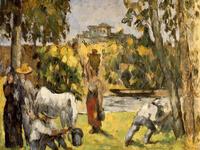
Life in the Fields
Paul Cezanne
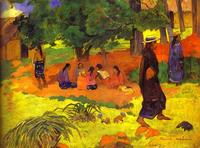
Taperaa Mahana
Paul Gauguin
Harvesting Perales
Fernando Amorsolo
Picking Apples
Camille Pissarro
The Call
Paul Gauguin
Cowgirl, Eragny
Camille Pissarro
Egry József, Hazafelé
Egry József
Bucolic
Henri Martin
Haying at Mezy
Berthe Morisot
Whispered Words
Paul Gauguin
Mango pickers (Martinique)
Paul Gauguin
Tropical Conversation
Paul Gauguin
Tahitian village
Paul Gauguin
No Cafezal
Georgina de Albuquerque
Under the Mango Tree
Fernando Amorsolo
The Gardener
Georges Seurat
Woman with a Daffodil
Augustus John
In the Garden
James Charles
The digger
Egisto Ferroni
The landlady
Silvestro Lega