The queen of beauty
Details
Expertenanalyse zu Paul Gauguins The queen of beauty
Stil: Post-Impressionism · Genre: sketch and study
Expert Art Historical Analysis: The Queen of Beauty by Paul Gauguin
Artwork: The Queen of Beauty
Artist: Paul Gauguin
Style: Post-Impressionism
Genre: Sketch and study
Period: 2nd Tahiti period
Significance within Post-Impressionism and Gauguin’s Oeuvre
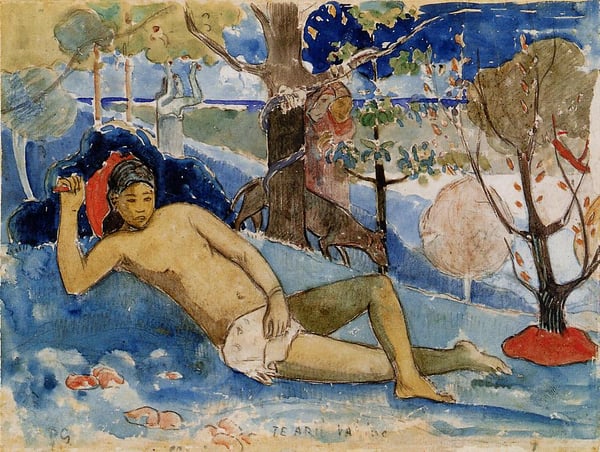
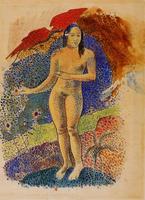
The Queen of Beauty is a compelling example of Gauguin’s mature Tahitian work, executed during his second Tahiti period (1895–1901). This phase marks a deepening of his symbolic, anti-naturalistic style, moving further away from European conventions toward a synthesized, mythic vision of Polynesian life. As a sketch and study, the work offers a rare, intimate glimpse into Gauguin’s process—revealing how he distilled observed reality into the flattened, boldly colored, and spiritually charged forms that define Post-Impressionism.
Key Elements of Significance
-
Rapid, Expressive Draftsmanship
Unlike his finished canvases, this sketch captures Gauguin’s immediate response to his subject. The loose, energetic lines and unblended patches of color demonstrate his emphasis on emotional and symbolic content over detailed naturalism—a hallmark of Post-Impressionism’s break from Impressionist optical accuracy. -
Thematic Resonance of the “Queen of Beauty”
The title suggests an idealized, possibly allegorical figure. In Gauguin’s Tahitian work, women often embody a fusion of earthly sensuality and sacred mystery. This study may have been a preparatory step for a larger painting, allowing him to explore composition, pose, and the rhythmic integration of figure and background—a key concern in his quest for “synthetic” harmony. -
Document of the Second Tahiti Period
Gauguin’s second stay in Tahiti was marked by disillusionment with colonial encroachment and a turn toward even more symbolic, monumental works. Studies like this one show his evolving simplification of form, where outlines become decorative and colors carry symbolic weight (e.g., warm earth tones evoking the ‘primal’ Paradise he sought to construct). -
Insight into Artistic Process
As a sketch, The Queen of Beauty illuminates Gauguin’s method of working from life while simultaneously transforming it. The visible pentimenti (reworked lines) and unfinished areas reveal his rigorous search for the essential—a process that directly influenced later movements such as Fauvism and Expressionism.
Conclusion
Though modest in scale and finish, The Queen of Beauty is a vital artifact of Gauguin’s second Tahiti period. It encapsulates the Post-Impressionist tension between observation and abstraction, and serves as a testament to his radical redefinition of artistic beauty—not as mimesis, but as a vessel for spiritual and cultural myth-making. For scholars, it is an indispensable key to understanding the genesis of his most iconic mature works.
Visuell ähnlich
20 Werke mit ähnlicher Komposition und Farbpalette
The King's Wife
Paul Gauguin
The Picnic
Salvador Dali
Exotic Eve
Paul Gauguin
Bathers
Paul Serusier
Adam and Eve
Paul Gauguin
Badende
Otto Mueller
Te Nave Nave Fenua (Delightful Land)
Paul Gauguin
Cherubs
Maurice Prendergast
The Bathers
Paul Gauguin
Bathing Girls
Franz Marc
A breton boy
Paul Gauguin
Venus
Mikhail Larionov
Delectable Waters
Paul Gauguin
The loss of virginity (Awakening of spring)
Paul Gauguin
Phantasy
Rupert Bunny
The Joy of Life
Henri Matisse
Zwei Akte Am See
Otto Mueller
Longing for Pure Love
Bertalan Por
Tahitian Eve
Paul Gauguin
Zwei Mädchen
Otto Mueller