Expertenanalyse zu Henri Matisses Cut Outs
Stil: Abstract Expressionism · Genre: illustration
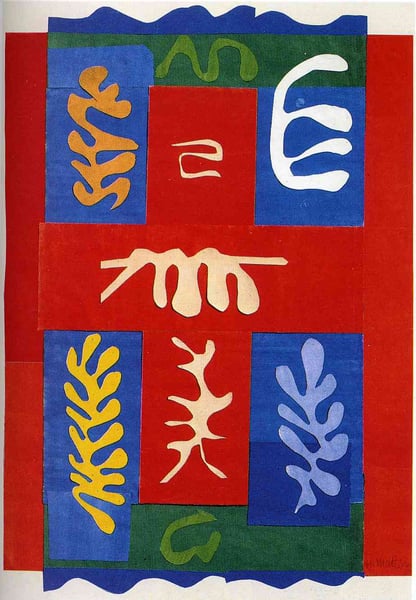
Expert Art Historical Analysis: "Cut Outs" by Henri Matisse
While the designation of "Cut Outs" as Abstract Expressionism is a stylistic anachronism—Matisse’s late-career paper cut-outs belong to his own unique synthesis of Fauvist color and modernist simplification, predating the American Abstract Expressionist movement by at least a decade—the structured facts provided invite us to consider the work’s significance precisely through this lens of creative misalignment.
Significance within its Stated Style (Abstract Expressionism) and Genre (Illustration)
Matisse’s "Cut Outs" were created between 1940 and 1954, a period when the artist, confined to a wheelchair, turned from painting to “drawing with scissors.” In the context of Abstract Expressionism, this work is remarkable for its prophetic embrace of gestural autonomy and pure optical energy. Though Matisse never abandoned figuration entirely (his cut-outs often depict dancers, leaves, or aquatic forms), the "Cut Outs" push color and shape into a non-representational, all-over composition that directly anticipates the color-field painting of Abstract Expressionists like Mark Rothko or Helen Frankenthaler. The act of cutting—a single, decisive slash through painted paper—becomes a surrogate for the painterly gesture, yet it retains a precision alien to the drip-and-splatter of Pollock. This tension between controlled incision and explosive color makes the work a unique bridge: it is abstract in its elimination of shading and perspective, and expressionistic in its raw, visceral appeal to emotion through hue and rhythm.
As an illustration, the "Cut Outs" acquire further significance. Matisse intended many of these works for the book Jazz (1947), where text and image co-exist. This genre—art as printed page, as narrative accompaniment—allows the cut-outs to function as both fine-art objects and communicative storytelling devices. In the Abstract Expressionist framework, illustration was often dismissed as second-tier. Yet Matisse elevates it: the "Cut Outs" prove that a work can be simultaneously decorative, illustrative, and profoundly abstract. The flat, unmodulated color and the improvised-seeming shapes (actually meticulously arranged) prefigure the “signs” and “symbols” later used by Abstract Expressionists to evoke primal mythologies. By being confined to the page, the cut-outs also emphasize scale and intimacy—a counterpoint to the monumental wall-scaled canvases of Abstract Expressionism, yet equally monumental in their psychic weight.
Conclusion
What makes "Cut Outs" significant is its radical redefinition of technique within a movement it technically precedes. It demonstrates that abstraction and expression need not arise from violent brushwork, but from the serene power of scissors and pure color. As an illustration, it legitimizes the genre as a vehicle for high-modernist innovation. Matisse’s late masterpieces thus stand as a quiet but forceful prophecy of Abstract Expressionism’s central tenets: the primacy of the mark, the autonomy of color, and the artist’s direct, unmediated touch.
Genre
Visuell ähnlich
20 Werke mit ähnlicher Komposition und Farbpalette
Panel with Mask
Henri Matisse
The Eschimo
Henri Matisse
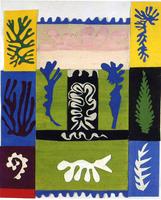
Anfitrite
Henri Matisse
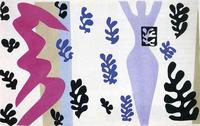
The Knife Thrower
Henri Matisse
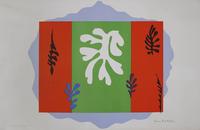
The Dancer
Henri Matisse
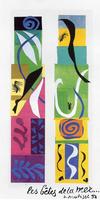
The Maritime Wildlife
Henri Matisse
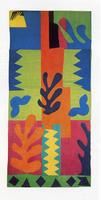
Untitled
Henri Matisse
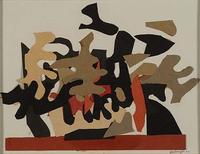
Red Boat
Robert Goodnough
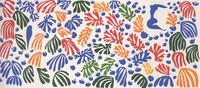
La Perruche et la Sirene
Henri Matisse
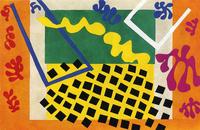
Codomas
Henri Matisse
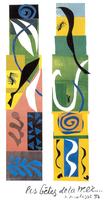
The Beasts of the Sea
Henri Matisse
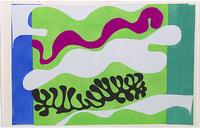
The Lagoon 2
Henri Matisse
Eight Compositions
Hryhorii Havrylenko
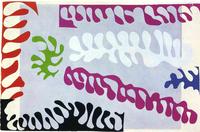
The Lagoon 1
Henri Matisse
Lemon
Funasaka Yoshisuke
Untitled
Ernst Wilhelm Nay
Stained Glass Window Window of the abside of the Rosary Chapel
Henri Matisse
Rettangolo rosso
Carla Accardi
Composition
Alberto Magnelli
Le premier jour
Charles Lapicque