Expertenanalyse zu James Tissots At The Louvre
Stil: Realism · Genre: genre painting
Expert Analysis of "At The Louvre" by James Tissot
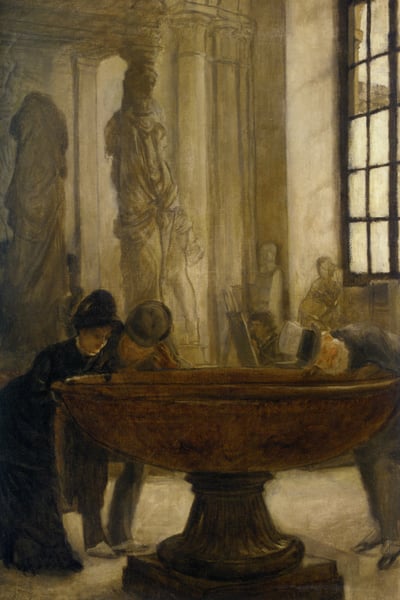
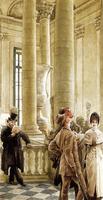
As a Realist genre painting, James Tissot’s “At The Louvre” derives its significance from its unflinching, detailed observation of contemporary life—specifically, the intersection of art, leisure, and social performance in 19th-century Paris. The work epitomizes the Realist commitment to depicting the ordinary world without idealization, yet it elevates a seemingly mundane museum visit into a rich commentary on class, fashion, and the commodification of culture.
Key aspects of its significance:
-
Authenticity of setting and gesture: True to Realist principles, Tissot captures the precise atmosphere of the Louvre—marble floors, gilt frames, and the specific postures of visitors. The figures are not allegorical or heroic; they are identifiable types: the absorbed tourist, the fashionable woman, the reflective flâneur. This specificity grounds the painting in its era, making it a historical document of museum culture.
-
Psychological depth within the genre: While genre painting often tells a simple story, Tissot imbues the scene with subtle social tension. The way figures interact with the artwork—some gazing, others ignoring it in favor of social display—reveals a critical Realist eye. It questions whether the Louvre functions as a temple of aesthetic devotion or a stage for personal vanity.
-
Significance within Realism’s broader aims: The work exemplifies how Realist genre painting moves beyond mere anecdote to explore modern urban experience. The museum becomes a microcosm of Parisian society, where class and taste are performed. Tissot’s meticulous rendering of textures (silks, carpets, gilded frames) and his precise compositional balance reinforce the Realist creed: truth to the visible world, even in an artificial, curated space.
In sum, “At The Louvre” is significant because it secures Realist genre painting’s ability to critique modernity through the lens of the everyday. It transforms a casual outing into a sharp observation of how people relate to art—and to each other—in the age of the museum.
Visuell ähnlich
20 Werke mit ähnlicher Komposition und Farbpalette
Philosopher Reading
Rembrandt
In the brewery in Munich
Philip de Laszlo
Purification After Childbirth
Harriet Backer
Parable of the Workers in the Vineyard
Salomon Koninck
Alexander the Great before the Tomb of Achilles
Heinrich Schonfeld
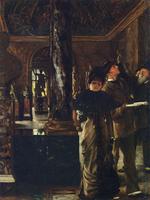
Foreign Visitors at the Louvre
James Tissot
Statement of the model in the studio of Ilya Repin Academy of Arts
Boris Kustodiev
A Scholar in his Study
Salomon Koninck
Greenwich Pensioners At The Tomb Of Nelson
John Everett Millais
Dinner in a Great Room with Figures- in Costume
J.M.W. Turner
An Underground Casualty Clearing Station, Arras
Henry Tonks
Pain
Angelo Dall'Oca Bianca
Pashur Smiting Jeremiah in the Temple
Leonaert Bramer
Woman and child in basement
Abraham van Strij
Salome in Prison
Gustave Moreau
Tobit and Anna with the Kid
Rembrandt
At The Louvre
James Tissot
Estaminet - Flemish Tavern
Lesser Ury
The Writer
Carl Spitzweg
Parable of the Laborers in the Vineyard
Rembrandt