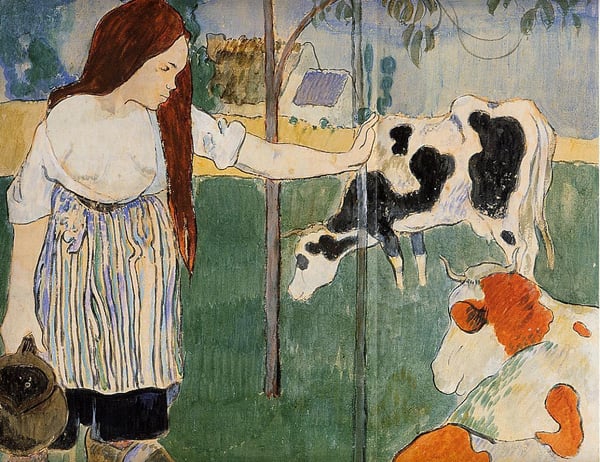
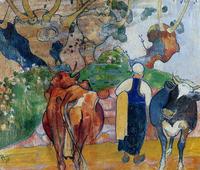
This analysis focuses on the significance of Paul Gauguin’s The Milkmaid within the context of its Cloisonnist style, its genre painting character, and the artist’s Breton period.
Art Historical Significance
The Milkmaid is a pivotal work from Gauguin’s Breton period, a time when he abandoned Impressionist naturalism in favor of a more symbolic, synthetic approach. Executed in the Cloisonnist style—a term borrowed from medieval enameling—the painting is defined by its bold, dark outlines that enclose vibrant fields of almost unmodulated color. This technique flattens pictorial space, reducing depth to a series of decorative, patterned planes.
As a genre painting, the work elevates an ordinary peasant activity—a milkmaid at work—into a timeless, emblematic image. Gauguin does not aim for documentary accuracy; instead, he simplifies forms (the rounded jug, the figure’s robust silhouette) and uses strong, arbitrary colors (such as the red ground or the green highlights) to evoke the spiritual essence of rural Breton life. The painting’s significance lies in how it bridges Post-Impressionist experimentation with the Symbolist desire to express inner truth through form and color, foreshadowing the synthetist ideals Gauguin would fully develop later in Tahiti.