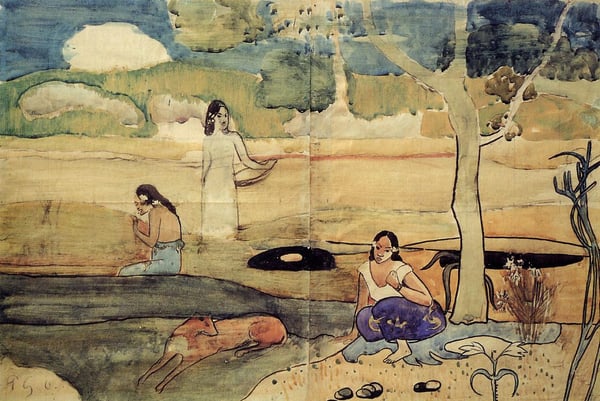
Tahitian Scene
Dettagli
Analisi esperta di Tahitian Scene di Paul Gauguin
Stile: Japonism · Genere: genre painting
Expert Analysis: "Tahitian Scene" by Paul Gauguin
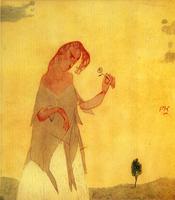
Paul Gauguin’s Tahitian Scene, executed during his first Tahiti period (1891–1893), is a seminal work that crystallizes his radical departure from Western naturalism. While the painting belongs to the genre of everyday life, its significance lies in how Gauguin synthesizes the visual language of Japonism with his personal, symbolic vision of Tahiti.
Key Significance:
-
Synthesis of Japonist Principles with Tahitian Subject Matter
Gauguin was profoundly influenced by Japanese ukiyo-e woodblock prints, which he collected and studied. In Tahitian Scene, this manifests in:- Asymmetrical composition and unexpected cropping of figures, reminiscent of Hokusai or Hiroshige.
- Flat, unmodulated color planes with bold, dark outlines (cloisonnism), borrowing from the graphic clarity of Japanese prints.
- Decorative use of pattern, such as the rhythmic placement of foliage or fabric, flattening pictorial space and echoing the Japanese love of surface ornament.
-
A Defining Work of Gauguin’s First Tahitian Period
This period marked his attempt to escape European civilization and find a “primitive” authenticity. Tahitian Scene is significant because it does not aim for ethnographic accuracy. Instead, Gauguin uses the island—its people, landscapes, and rituals—as a vehicle for symbolic and emotional expression. The work employs synthesism (simplified forms, bold colors, and ideographic symbolism) to evoke a timeless, spiritualized vision of life, merging reality with myth. -
Rejection of Perspective and Naturalism
Following Japonist practice, Gauguin abandons linear perspective and chiaroscuro. Figures and landscape elements are arranged in a shallow, frieze-like space, emphasizing the two-dimensional picture plane. This radical flattening was a direct challenge to Western academic painting and became a foundational influence on later modernist movements, such as Primitivism and Fauvism. -
Cultural and Artistic Cross-Pollination
Tahitian Scene exemplifies Gauguin’s unique fusion of Oceanic motifs (the lush vegetation, the relaxed posture of Tahitian women) with European Japonist aesthetics. The result is a highly stylized, decorative harmony that subverts genre painting conventions—transforming a simple daily scene into a contemplative, exotic reverie. This blend helped redefine the purpose of painting: from depicting reality to conveying an inner, symbolic truth.
Conclusion:
In Tahitian Scene, Gauguin achieves a pivotal synthesis of Japonism and Polynesian subject matter, forging a new, anti-naturalistic pictorial language. Its significance lies in its radical simplification, flatness, and symbolic intensity—qualities that not only defined his first Tahiti period but also prefigured the course of modern art in the 20th century.
Museum / Gallery
Visivamente simili
20 opere con composizione e palette affini
Arearea I
Paul Gauguin
Badeszene Mit Vier Figuren, Haus Und Boot (nach Rechts)
Otto Mueller
Easter Picture
Florine Stettheimer
Couples in Conversation
Oskar Kokoschka
Sitzende Und Badende Mit Zwei Bäumen
Otto Mueller
Moses and the Shepherd
Hossein Behzad
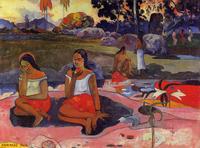
Sacred Spring
Paul Gauguin
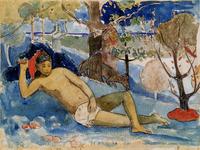
The queen of beauty
Paul Gauguin
Landscape with Three Figures
Konstantinos Parthenis
Badende
Otto Mueller
Moses and the Striking Rock
Marc Chagall
The Pearl of Love, from The Kingdom of the Pearl
Edmund Dulac
Olden times
Paul Gauguin
The encounter
Paul Gauguin
Figures in a Landscape
Maurice Prendergast
Tahitian pastorale
Paul Gauguin
Scene paysanne
Grégoire Michonze
The Sleepers
Oskar Kokoschka
An allegory of propaganda
Paul Klee
Margaret
Charles Robinson