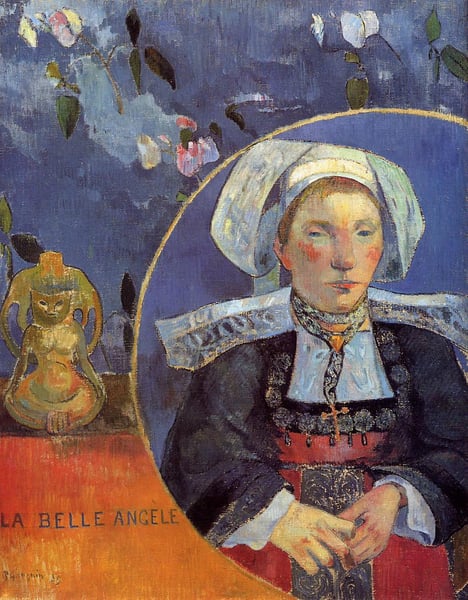
The Beautiful Angel (Madame Angele Satre, the Innkeeper at Pont-Aven)
Dettagli
Analisi esperta di The Beautiful Angel (Madame Angele Satre, the Innkeeper at Pont-Aven) di Paul Gauguin
Stile: Synthetism · Genere: portrait
Expert Analysis: "The Beautiful Angel (Madame Angèle Satre, the Innkeeper at Pont-Aven)" by Paul Gauguin
This portrait, created during Gauguin’s Breton period, stands as a defining work of Synthetism—a style he championed that rejected naturalistic representation in favor of subjective expression. Painted in Pont-Aven, the piece features Madame Angèle Satre, an innkeeper, yet Gauguin elevates the mundane into the symbolic, a core tenet of Synthetism.
Significance within Synthetism:
The painting exemplifies Synthetism’s hallmark: the "synthesis" of form, color, and feeling. Gauguin reduces the figure to flat, unmodulated planes of color—deep blues, warm yellows, and stark whites—outlined with bold, cloisonné-like contours. This technique flattens depth, prioritizing decorative pattern over illusionistic space. The titular "angel" is not a literal halo but a symbolic aura created by the juxtaposition of the woman’s serene expression against a vivid, abstracted background. Gauguin merges reality (a working-class innkeeper) with an idealized, almost mystical presence, embodying Synthetism’s drive to distill emotion and meaning through simplified forms.
Significance within the Breton Period:
Gauguin’s time in Brittany profoundly shaped his rejection of Impressionism. Here, local Breton culture—its folk traditions, religious fervor, and rural simplicity—became a vehicle for synthetic expression. Madame Satre is not merely a portrait subject; she is a synthesis of Breton identity: earthy, resilient, yet imbued with a quiet spirituality. The stark composition and bold palette reflect Gauguin’s belief that the artist should “suggest” rather than “describe,” capturing the essence of Breton life rather than its literal appearance. This work foreshadows his later, more radical Tahitian pieces, marking a pivotal moment where personal vision overtakes external observation.
Conclusion:
"The Beautiful Angel" is significant as a mature statement of Synthetist principles within Gauguin’s Breton output. It demonstrates how portraiture could transcend likeness to become a vehicle for symbolic meaning, merging the everyday with the timeless. The painting’s flat, patterned structure and emotive color stand as a direct challenge to Impressionist naturalism, solidifying Gauguin’s role as a pioneer of post-impressionist abstraction.
Museum / Gallery
Visivamente simili
20 opere con composizione e palette affini
Bretonne
Roderic O'Conor
Portrait of Marie Lagadu
Paul Serusier
Head of a Breton (Marie Louarn)
Paul Gauguin
Bildnis Einer Jungen Magd
Thérèse Schwartze
Mother Marie Poussepin
Gwen John
Bildnis einer Ordensschwester in einem sommerlichen Garten
Wilhelm Trübner
Siberian Beauty. Portrait of E. A. Rachkovsky.
Vasily Surikov
Portrait of a Young Girl
Maurice Prendergast
La Montera. Segovia Girl in Fiesta Costume
Robert Henri
Portrait of a young maiden
Henry Mosler
Портрет молодої української дівчини
Микола Пимоненко
The Girl in the Cantine for Pilots
Felicien Rops
A Girl with Kokoshnik (Woman's Headdress in Old Russia)
Mikhail Nesterov
Mädchen Ölstudie
Paul Hoecker (Höcker)
Marie Poussepin Seated at a Table
Gwen John
Peasant woman from Upper Brittany
Alexandre Antigna
Portrait
Maria Bozoky
Une Jeune Bretone
Roderic O'Conor
Young Girl with a Large Cap on Her Head
Camille Corot
Head of a Peasant Woman with White Cap
Vincent van Gogh