The month of Maria
Dettagli
Analisi esperta di The month of Maria di Paul Gauguin
Stile: Cloisonnism · Genere: portrait
Expert Analysis: "The month of Maria" by Paul Gauguin
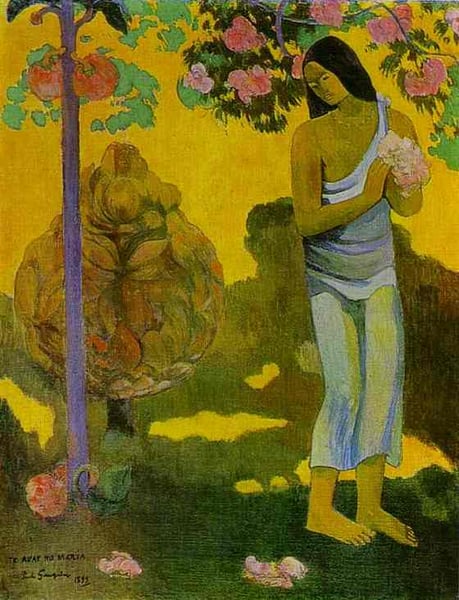
Paul Gauguin’s The month of Maria exemplifies the artist’s mature Cloisonnist style during his 2nd Tahiti period, marking a pivotal synthesis of Western symbolism and Polynesian spirituality. Executed as a portrait, the work transcends mere likeness to become a meditation on cultural and religious fusion—a hallmark of Gauguin’s late career.
Significance within Cloisonnism
Gauguin’s Cloisonnist technique here is defined by its emphatic, dark outlines and broad, unmodulated fields of color, reminiscent of medieval stained glass or cloisonné enamel. The figure is flattened, with simplified forms that prioritize symbolic meaning over naturalistic depth. In The month of Maria, the sitter—likely a Tahitian woman—is rendered with a serene, mask-like face, her skin a warm ochre against a vivid green or blue ground. The heavy contours isolate each color area, creating a decorative, almost abstract rhythm that directs the viewer’s gaze to the titular “Maria” reference: a subtle Christian iconography embedded in an exotic setting.
Significance within the 2nd Tahiti Period
During his second sojourn in Tahiti, Gauguin deliberately moved away from European academic traditions toward what he saw as a more “primitive” and authentic expression. The month of Maria embodies this shift by blending the local vahine (woman) with the Marian title, reflecting Gauguin’s fascination with the interplay of Tahitian mythology and imported Christianity. The portrait is not a literal depiction but a symbolic fusion: the woman’s pose and halo-like framing suggest the Virgin Mary, yet her attire and surroundings are distinctly Oceanic. This hybridization challenges colonial narratives, asserting that spirituality and beauty are universal, not bound by Western conventions.
Overall Artistic Impact
The month of Maria stands as a key work in Gauguin’s oeuvre because it condenses his core aesthetic and philosophical preoccupations: Cloisonnism’s formal boldness combined with Tahiti’s spiritual syncretism. The portrait rejects empirical observation in favor of emotional and mystical resonance, aligning with Gauguin’s goal to “paint from the imagination” and his belief that art should evoke a primal, timeless state. In this piece, the flat, luminous color patches and strong outlines create a visionary quality—an idealized fusion of earthly woman and divine mother—that would profoundly influence later modernists, from the Fauves to the Nabis.
Museum / Gallery
Visivamente simili
20 opere con composizione e palette affini
Tahitian pastorale
Paul Gauguin
Two tahitian women
Paul Gauguin
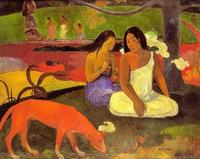
Arearea I
Paul Gauguin
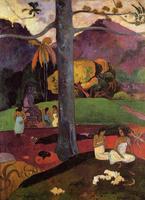
Olden times
Paul Gauguin
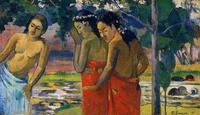
Three Tahitian Women
Paul Gauguin
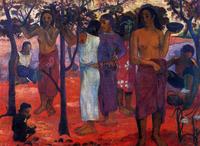
Perfect days
Paul Gauguin
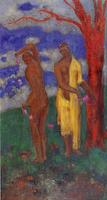
Two Women under a Red Tree
Odilon Redon
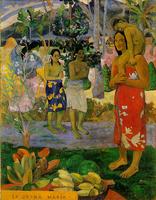
Ia Orana Maria (We Hail Thee Mary)
Paul Gauguin
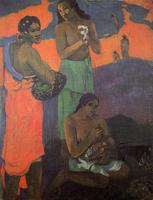
Maternity (Three Women on the Seashore)
Paul Gauguin
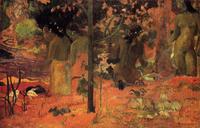
The Bathers
Paul Gauguin
Beach No. 3
Maurice Prendergast
Sacred Spring
Paul Gauguin
The Invocation
Paul Gauguin
Bathers
Paul Serusier
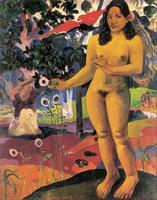
Te Nave Nave Fenua (Delightful Land)
Paul Gauguin
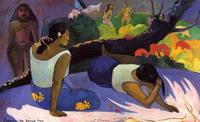
Reclining Tahitian Women
Paul Gauguin
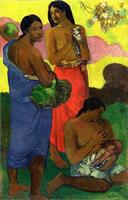
Maternite II
Paul Gauguin
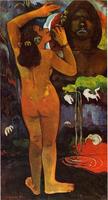
Hina, Moon Goddess and Te Fatu, Earth Spirit
Paul Gauguin
Delectable Waters
Paul Gauguin
The Call
Paul Gauguin