Analisi esperta di Slave of the queen retinue Shemakhan di Konstantin Korovin
Stile: Art Nouveau (Modern) · Genere: sketch and study
Artwork Analysis: "Slave of the Queen Retinue Shemakhan" by Konstantin Korovin
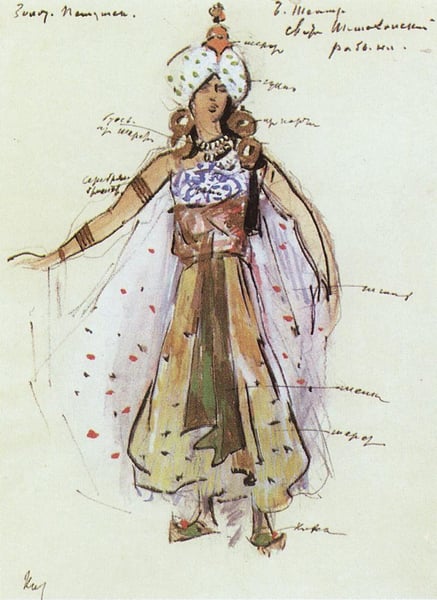
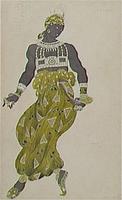
Konstantin Korovin’s "Slave of the Queen Retinue Shemakhan" is a vivid sketch and study that exemplifies the intersection of Russian theatrical design and the international Art Nouveau (Modern) style. While the work is a preparatory piece—likely created for a production such as Rimsky-Korsakov’s opera The Golden Cockerel, which features the Queen of Shemakhan—its significance lies in how it distills the core aesthetic principles of Art Nouveau through the lens of Korovin’s unique, luminous palette and fluid linework.
Significance within Art Nouveau and the Modern Period:
-
Decorative Line and Rhythmic Composition
As a study, this sketch captures Art Nouveau’s hallmark sinuous, organic curves. The figure’s posture and drapery are rendered in flowing, almost calligraphic strokes, suggesting movement and elegance. Korovin’s line is not merely descriptive but becomes an expressive element, echoing the whiplash curves found in works by Alphonse Mucha or the architectural details of Hector Guimard. This emphasis on dynamic, decorative linework situates the piece within the broader Modernist search for a unified visual language that transcends fine art and applied design. -
Theatrical Synthesis of Russian Folk Motifs and Modernism
Although the subject is fictional (a slave in the retinue of the mythical Queen of Shemakhan), Korovin imbues it with a distinctly Russian interpretation of Orientalism. The exoticized costume and pose reflect the era’s fascination with “the East” as filtered through Russian folklore. Korovin’s handling of color—bright, almost shimmering in its lightness—demonstrates his training as a colorist and his departure from academic realism. In this sketch, color is applied in loose, free washes, prioritizing atmosphere and symbolic mood over strict naturalism. This aligns with Art Nouveau’s embrace of stylization and emotional resonance. -
The Sketch as a Finished Statement
The work’s genre as a “sketch and study” is crucial to its significance. In the Modern period, the unfinished or preparatory work began to be valued for its direct expression of the artist’s hand and creative process. Korovin’s study preserves the spontaneity of his initial vision: the quick, confident strokes, the absence of rigid outlines, and the suggestion of a background that dissolves into pure color. This raw immediacy contrasts with the often elaborate finishes of Art Nouveau decorative arts, revealing the artist’s keen observational skill and his ability to suggest form with minimal marks. -
Influence on Stage Design
Korovin was a pioneering stage designer for the Russian opera and ballet, and this study likely served as a costume sketch. The Art Nouveau style, with its emphasis on total aesthetic environments, found a natural home in the theater. Korovin’s talent for evoking texture and light through paint—here, the silks and fabrics of the slave’s attire—helped define the visual identity of productions at the Bolshoi and Mariinsky theaters. This work exemplifies how a quick study could capture the essence of a character, making it a vital part of the collaborative process of theatrical art.
In summary, "Slave of the Queen Retinue Shemakhan" is significant as a prime example of Russian Art Nouveau filtered through theatrical imagination. It demonstrates Korovin’s mastery of decorative line and color, his ability to synthesize folkloric romance with modern stylization, and the period’s revaluation of the sketch as a legitimate, expressive art form.
Visivamente simili
20 opere con composizione e palette affini
Dancer.Costume design for Rubinstein`s opera
Konstantin Korovin
Le dieu bleu the bride
Leon Bakst
Khan's wife, costume design for C.Pugni`s ballet
Konstantin Korovin
Persian
Konstantin Korovin
Two sketches of costumes
Sergey Solomko
Volkhova, the sea princess (Costume design for the opera "Sadko")
Mikhail Vrubel
Captive
Nicholas Roerich
The Firebird
Leon Bakst
Istar Ida Rubinstein as Istar
Leon Bakst
Prince Guido (Costume design for the opera "The Tale of Tsar Saltan")
Mikhail Vrubel
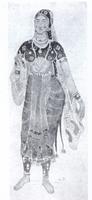
Captive
Nicholas Roerich
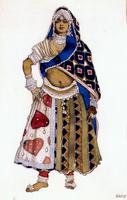
Le dieu bleu bayadere
Leon Bakst
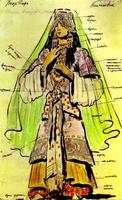
Konchakovna
Konstantin Korovin
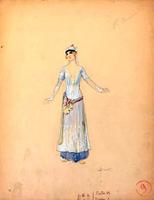
Costume Designs
Sergey Solomko
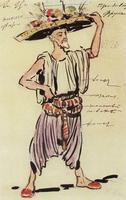
Fruit seller.Costume design for Gartman`s ballet
Konstantin Korovin
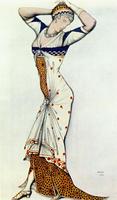
Design for a lady's dress
Leon Bakst
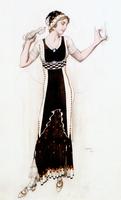
Fantasy on modern costume (atalanta)
Leon Bakst
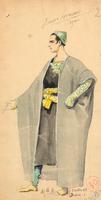
Costume Designs
Sergey Solomko
Negro gold Drawing Shéhérazade costume, ballet Diaghilev
Leon Bakst
Princess Anfisa
Boris Kustodiev