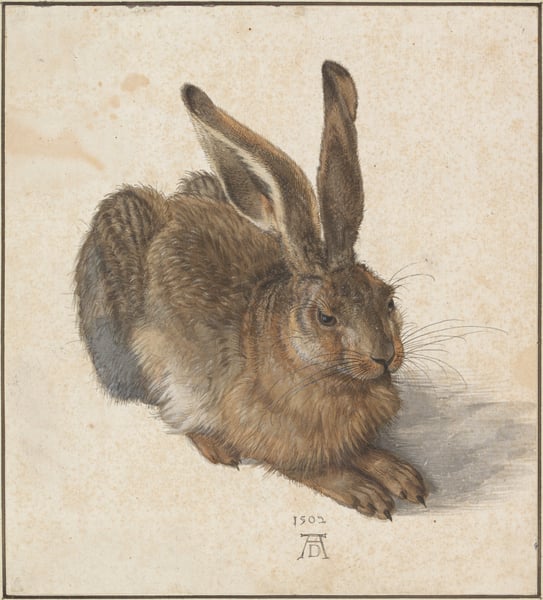
Young Hare
Dettagli
Description
Stile: Northern Renaissance · Genere: animal painting
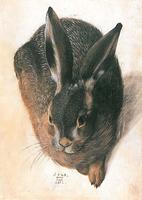
The watercolor, A Young Hare (1502), is one of the most famous examples of Dürer’s study of nature and animals. The artwork is significant, not only because it demonstrates Dürer’s supreme craftsmanship, but also because it provides insight into Dürer’s understanding of the relationship between art and nature. The Renaissance brought about the development of new techniques of representation, such as the study of proportions, perspective and imitation of nature. When visiting Italy in the late 1490s, Dürer got acquainted with many of these techniques and brought over the newly acquired knowledge back to Germany. For this reason, much of Dürer’s artwork from the early 1500s, including A Young Hare, expressed his interest in nature.
The artist understood the importance of observing nature, stating: “Depart not from Nature… for Art is rooted in Nature, and whoever can pull it out, has it”. The quote shows Dürer’s position on the relation between art and nature, and how studying and emulating nature is crucial to artistic creation. Another central principal in Dürer’s perception of nature was diversity, meaning that every specimen and detail in nature has a distinctive character that should be captured. In other words, Dürer’s intention was not to create an archetypical form or rely purely on the general characteristics of an animal or plant. Dürer conceived the hare with exceptional virtuosity, paying attention to the minutest details, such as the hare’s whiskers and eyes. The artist captures its shy and fragile nature, showing great empathy and affection for the small animal.
The method by which Dürer managed to reach this level of accuracy is a point of discussion. At this period, methods of animal stuffing were not yet existent, hence Dürer did not have an option of copying a stuffed model. Likely, Dürer created preparatory sketches of the animal in the wild, and relied on his memory to complete the watercolor. It is also possible that the artist studied a dead animal or caught a live animal and kept it in his workshop.
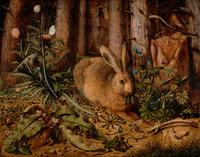
In this case, the subject of the hare is presented in a non religious and non symbolic context. This aligns with Dürer’s perception of nature and his pure interest in studying nature (animals, landscapes and plants). An interesting aspect of the watercolor is the background. Dürer chose to present the hare in a white space rather than its natural habitat, like a forest or meadow. The neutral background was used by Dürer repeatedly, in artworks such as Head of a Stag (ca. 1503), The Little Owl (1506) and Wing of a Blue Roller (1512). In the case of A Young Hare, some point out Dürer paints a reflection of a window in the hare’s eye, suggesting that the animal was drawn in the artist’s studio. Nevertheless, this is speculative because this technique was commonly used by Dürer. Many of Dürer’s successors and students copied the drawing, however they always placed the animal in a natural environment, such as a meadow or a forest. An example of this is A Hare in the Forest (ca. 1585) by Hans Hoffmann, who based this oil painting on Dürer’s watercolor.
Museum / Gallery
Visivamente simili
20 opere con composizione e palette affini
Hare
Albrecht Durer
A Young Hare (after Durer)
Hans Hoffmann
Hare
Albrecht Durer
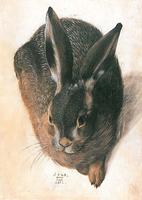
Hare
Hans Hoffmann
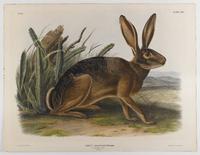
California Hare
John James Audubon
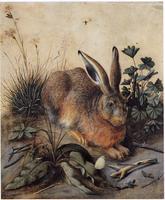
Lievre Entoure De Plantes
Hans Hoffmann
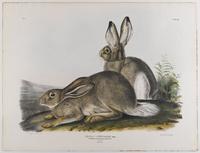
Townsend's Rocky Mountain Hare
John James Audubon
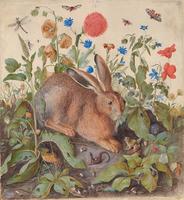
Hare
Hans Hoffmann
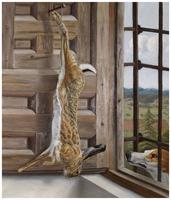
Still life with dog
Francisco Franco
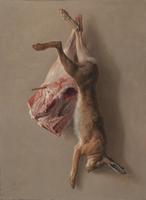
A Hare and a Leg of Lamb
Jean-Baptiste Oudry
Jack Rabbit
Frederick Sommer
Hare
Pyotr Konchalovsky
Hare
Gustave Caillebotte
Dead Hare
James Ward
Faery Hare
Brian Froud
Illustrations for Mikhail Stelmakh's book "In the Hedgehog's Windmill"
Hryhorii Havrylenko
He Said I am Surprised I Expect its a Party
Charles Robinson
Hanging Hare
Chaim Soutine
White Rabbit
Jan Mankes
A Hare in the Forest (after Durer)
Hans Hoffmann