Analisi esperta di The Tree di Henri Le Fauconnier
Stile: Cubism · Genere: landscape
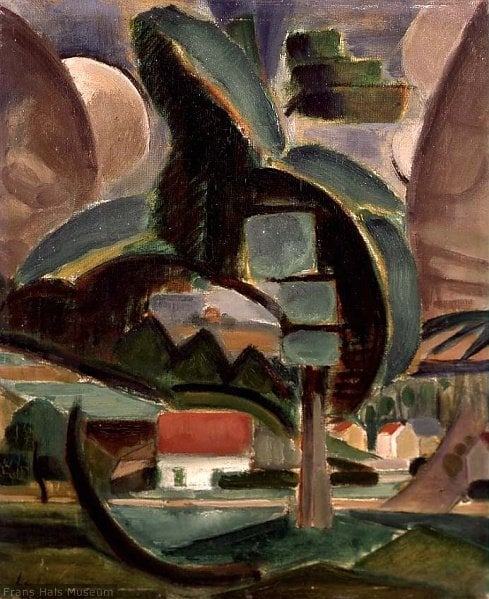
Henri Le Fauconnier’s The Tree is a landmark within the development of Cubist landscape painting, showcasing how the movement’s principles could be applied beyond the traditional studio subjects of still life and portraiture. As a member of the Salon Cubists, Le Fauconnier was instrumental in bringing Cubism to a wider public, and this work exemplifies his distinct approach.
Significance within Cubism and Landscape:
-
Reinterpreting Nature through Geometry: Unlike the more analytical, monochromatic works of Picasso and Braque, Le Fauconnier’s The Tree retains a vibrant, structured palette while fracturing the landscape into faceted planes. The titular tree is not rendered as a naturalistic form but as a dynamic, crystalline structure that anchors the composition. This approach—dissecting organic shapes into geometric shards—demonstrates Cubism’s radical rethinking of representation, where the essence of a tree is conveyed through its underlying volumes and spatial relationships rather than its literal appearance.
-
Synthesis of Figure and Ground: In this landscape, the boundaries between the tree, the sky, and the ground are deliberately blurred. Le Fauconnier uses overlapping, translucent planes to create a sense of movement and depth that is independent of traditional perspective. This fuses the subject with its environment, a hallmark of Cubist thought where the object is no longer isolated but part of a continuous, unified pictorial field.
-
A Bridge to Later Developments: The Tree is significant for its influence on the transition from early Cubism toward more expressive, color-driven forms of modernism. By injecting emotional intensity into the geometric framework—through bold contour lines and a warm, earthy palette—Le Fauconnier anticipates the Synthetist and Orphist tendencies that would soon push Cubism into more abstract and color-saturated territory.
In summary, The Tree stands as a vital example of how Cubism could rejuvenate the landscape genre, proving that the movement’s analytical rigor was equally capable of capturing the living, structural pulse of nature. Le Fauconnier’s work here is not merely a dissection but a re‑assembly of the natural world into a powerful, immersive vision.
Visivamente simili
20 opere con composizione e palette affini
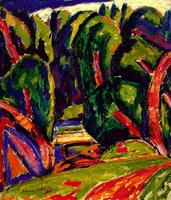
Red Tree
Marsden Hartley
Green Landscape
Amadeo de Souza-Cardoso
Winter Landscape
Kazimir Malevich
Landscape, near Nice
Graham Sutherland
Autumn in Murnau
Wassily Kandinsky
Paysage Au Grand Arbre
Bela Czobel
Beyond the Radiant Valley (Reiderfurka)
Alice Bailly
Untitled
Albert Gleizes
Landscape near Cassis
Andre Derain
White Night
Edvard Munch
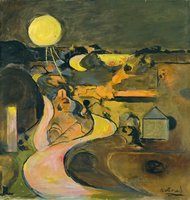
Road to Porthclais with Setting Sun
Graham Sutherland
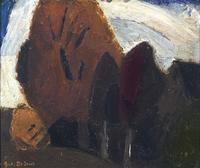
Arbres
Gustave de Smet
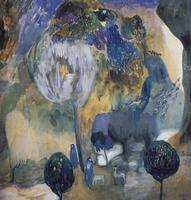
Blossoming mountains
Martiros Sarian
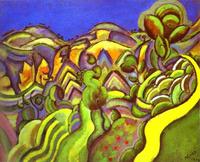
Ciurana, the Path
Joan Miro
Houses with Trees
Janos Mattis-Teutsch
Lesson Demonstration, Burford
Frances Hodgkins
Garden on Lake Thun
August Macke
Cubist Landscape ( The City Park)
Kmetty János
Landscape
Andre Derain
Above the Trees
Emily Carr