
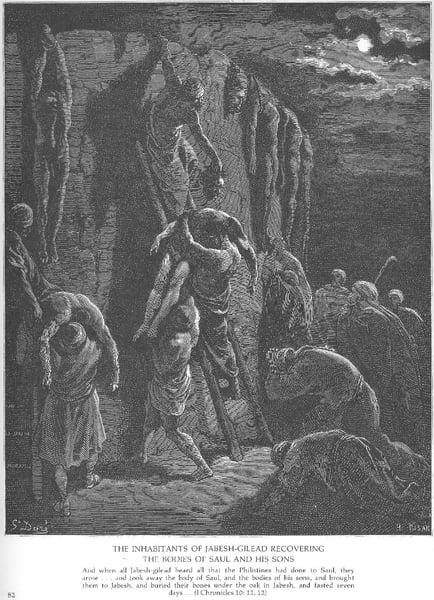
Deskundige analyse van Jabesh-Gileadites Recover the Bodies of Saul and His Sons van Gustave Dore
Stijl: Romanticism · Genre: religious painting
Expert Analysis of "Jabesh-Gileadites Recover the Bodies of Saul and His Sons" by Gustave Doré
Significance within Romanticism and Religious Painting
Gustave Doré’s Jabesh-Gileadites Recover the Bodies of Saul and His Sons is a masterful example of Romantic religious painting, where the artist transforms a biblical episode into a visceral, emotionally charged drama. Created as part of Doré’s monumental illustrated Bible (1866), this work synthesizes Romanticism’s core preoccupations—sublime nature, human pathos, and moral grandeur—with the solemn gravity of sacred history.
Narrative and Composition
The scene depicts a passage from 1 Samuel 31:11–13, where the valiant men of Jabesh-gilead travel by night to retrieve the mutilated bodies of King Saul and his sons from the walls of Beth-shan, bringing them back for proper burial. Doré captures the bleak aftermath of battle: a moonlit landscape, the fortress looming in the background, and a procession of figures bearing the corpses with reverent urgency. The composition is theatrical yet somber, leading the eye from the distant walled city to the foreground group—each figure slumped under the weight of grief duty.
Romantic Sensibility
- Emotion and Sublimity: Doré employs chiaroscuro—deep shadows against bursts of pale moonlight—to evoke a mood of mourning and awe. This is not a tranquil pietà but a raw, nocturnal rescue; the darkness suggests both the horror of war and the sanctity of the mission.
- Heroic Humility: Romanticism often celebrates the individual’s noble action against overwhelming odds. Here, the Jabesh-gileadites are ordinary men undertaking a sacred, risky act, their anonymity underscoring universal human compassion.
- Nature as Mirror: The rugged terrain and stormy sky reflect the turmoil of the narrative. Romantic artists often used landscape to amplify psychological states—the barren hills and jagged rock convey desolation, while the moon’s cold light suggests a divine witness.
Religious and Historical Context
Doré’s interpretation is significant because it moves beyond static devotional imagery. Instead of focusing on Saul’s tragic downfall or divine judgment, he highlights the communal act of honoring the dead—a theme of mercy and restoration. The work aligns with Romantic religious painting by prioritizing human empathy and moral duty over doctrinal illustration. Doré’s dramatic, almost cinematic treatment would later influence film and graphic narrative, showing how Romantic principles could revitalize biblical art for a modern audience.
Legacy
This engraving (and its companion in Doré’s Bible) stands out for its ability to fuse historical authenticity with emotional immediacy. It exemplifies Romanticism’s shift from idealized, hieratic religious art to a deeply humane, psychologically resonant vision—where faith is embodied not in miracles, but in the courage of ordinary people to reclaim dignity from oblivion.
Visueel vergelijkbaar
20 werken met verwante compositie en kleurenpalet
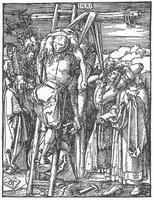
The Descent from the Cross
Albrecht Durer
Bertram De Born
Gustave Dore
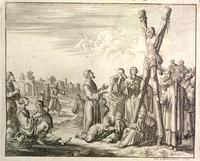
Crucifixion of Apostle Andrew, Patras in Achaia, AD 70
Jan Luyken
The tribute money
Rembrandt
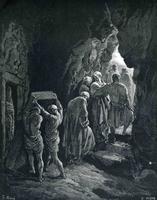
The Burial of Sarah
Gustave Dore
The Descent From TheCross
Gustave Dore
Rizpah's Kindness toward the Dead
Gustave Dore
The Rebuilding of the Temple Is Begun
Gustave Dore
The Lamentation for Christ
Albrecht Durer
The Avaricious
Gustave Dore
Schismatics--Mahomet
Gustave Dore
Geri Del Bello
Gustave Dore
Christ crucified between the two thieves an oval plate
Rembrandt
The Plague of Jerusalem
Gustave Dore
The People Mourning over the Ruins of Jerusalem, Lamentations 1:1-2
Gustave Dore
The descent from the cross by torchlight
Rembrandt
A young man seated and standing (The walking trainer)
Rembrandt
The Crucifixion an Oval Plate
Rembrandt
The Flagellation
Palma il Giovane
Christ Being Nailed to the Cross
Jan Luyken