The Beheading of John the Baptist
Jacopo Bellini sanatçısının The Beheading of John the Baptist eseri hakkında uzman analizi
Tarz: Early Renaissance · Tür: sketch and study
Expert Analysis: "The Beheading of John the Baptist" by Jacopo Bellini
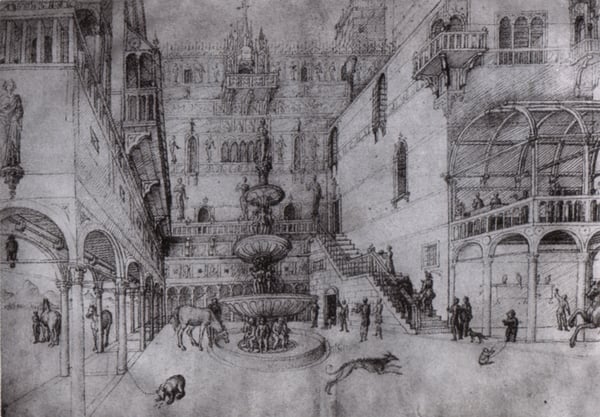
As a sketch and study from the Early Renaissance, Jacopo Bellini’s “The Beheading of John the Baptist” holds a pivotal place in the development of Venetian narrative art. Bellini was among the first Italian artists to systematically explore perspective and human emotion in preparatory drawings, and this work exemplifies that transition from the lingering Gothic tradition toward the more naturalistic Renaissance sensibility.
Significance within the Early Renaissance:
-
Narrative clarity and dramatic focus: The composition centers on the moment of execution, with John the Baptist’s bent head and the executioner’s raised sword creating a clear focal point. Bellini arranges the figures in a shallow, stage-like space—a hallmark of early Renaissance storytelling—ensuring the viewer reads the action without ambiguity. The sketch’s rapid, expressive lines capture the tension of the scene, something Bellini would refine in his more finished pieces.
-
Mastery of perspective and spatial depth: Even in a study, Bellini demonstrates his revolutionary interest in linear perspective. The architectural elements (a palace or courtyard setting) recede into the background, framing the beheading and grounding it in a believable, three-dimensional world. This skill, documented extensively in his famous sketchbooks, directly influenced his sons Gentile and Giovanni Bellini, who would become cornerstones of Venetian Renaissance painting.
-
Humanity and psychological insight: Unlike earlier, more hieratic treatments of saints, Bellini’s John is a vulnerable figure shown mid-action—his resignation palpable. The executioner is no mere symbol but a muscular, dynamic presence. The early Renaissance focused on making biblical stories relatable, and this sketch captures the raw human drama that would come to define the period’s devotional art.
-
Role as a preparatory study: The work’s genre as a sketch reveals Bellini’s working method. Rapid pen-and-ink strokes, combined with careful modeling (possibly with wash), show him testing compositional ideas, adjusting proportions, and experimenting with light and shadow. Such studies were rare to preserve, making this drawing an invaluable window into the creative process of a foundational Early Renaissance master.
In summary, “The Beheading of John the Baptist” is significant not only for its artistic merit but as a key document of the Early Renaissance’s shift toward naturalism, narrative coherence, and spatial realism. It foreshadows the achievements of the Bellini workshop and stands as a testament to Jacopo’s role in shaping Venetian art.
Museum / Gallery
Görsel olarak benzer
İlişkili kompozisyon ve renk paletine sahip 20 eser
Flagellation
Jacopo Bellini
Don Quixote
Gustave Dore
Dormition of the Virgin
Jacopo Bellini
Scala dei Giganti
Canaletto
Don Quixote
Gustave Dore
The Coronation of the Doge
Francesco Guardi
Constantine Palaeologus Haranguing the Defenders of Constantinople
Gustave Dore
Florence. The Palazzo Del Bargello
Gustav Bauernfeind
Model of the dance house in Basel
Hans Holbein the Younger
Don Juan Tenorio. Seville Street
Carlos Saenz de Tejada
Der Karneval
Georg von Rosen
Don Quixote
Gustave Dore
Rome, old Saint Peter's Basilica and the Vatican Palace
Maerten van Heemskerck
April. Fresco in Palazzo Schifanoia (detail)
Francesco del Cossa
The Escape of David through the Window
Gustave Dore
The Courtyard of the Palazzo Del Bargello. Florence
Jorgen Roed
Design for the facade decoration of the dance house in Basel
Hans Holbein the Younger
Presentation of the Virgin at the Temple
Jacopo Bellini
Stage design for Richard Wagner's opera "lohengrin", Act 2, dawn
Alfred Roller
Palermo cathedral, drawing by Leitch, engraving by J.H. Le Keux
William Leighton Leitch