
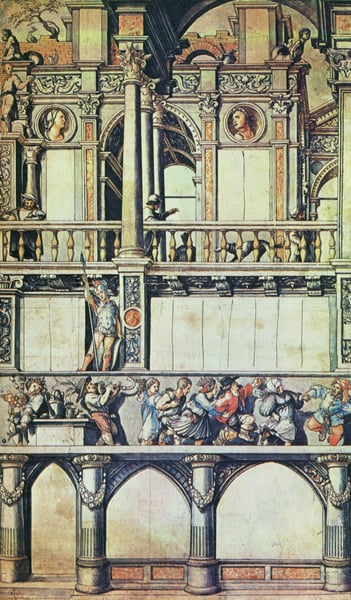
Analisi esperta di Design for the facade decoration of the dance house in Basel di Hans Holbein the Younger
Stile: Northern Renaissance · Genere: design
Expert Analysis: "Design for the Facade Decoration of the Dance House in Basel" by Hans Holbein the Younger
This work, executed in the Northern Renaissance style and categorized as a design (likely a preparatory drawing or architectural scheme), holds a unique position in Hans Holbein the Younger’s oeuvre and in the broader history of public art. Its significance lies in how it marries the intellectual rigor of Renaissance humanism with the vibrant, communal life of a 16th-century Swiss city.
1. A Rare Surviving Example of Civic Decoration Holbein is best known today for his penetrating portraits of the Tudor court, but this design reveals his earlier, ambitious work in Basel—a city that was a nexus for humanist thought and commerce. The dance house (a kind of public festival hall or guild venue) was a space for civic celebration, and Holbein’s facade scheme was intended to elevate such gatherings with allegorical and classical imagery. This piece is one of the few direct records of a large-scale architectural decoration project by Holbein, offering insight into his process as a designer and muralist.
2. Synthesis of Northern Tradition and Italianate Renaissance While the genre is a design, the composition reflects the Northern Renaissance’s characteristic attention to detail and narrative, combined with a newfound interest in classical architectural orders and perspective—a nod to the Italian Renaissance. The facade likely incorporates pilasters, friezes, and figurative scenes that would have referenced themes of harmony, dance, and social order. Holbein’s ability to adapt classical motifs (such as grotesques or putti) to a specifically Northern, public context demonstrates his role as a conduit for Renaissance ideas north of the Alps.
3. Integration of Life, Art, and Architecture The significance of this design extends beyond its visual appeal: it represents the Renaissance ideal of integrating art into daily urban life. The dance house was a venue for leisure and communal bonding, and Holbein’s decoration would have transformed it into a didactic as well as ornamental space. By combining allegorical figures (perhaps representing virtues like Temperance or Joy) with playful dancing scenes, he bridged high humanist concepts with the realities of civic festivity. This interplay—between the ideal and the real, the classical and the contemporary—is a hallmark of Holbein’s genius.
4. Technical and Stylistic Precision Even in a preparatory design, Holbein’s Northern Renaissance precision is evident. The balancing of architectural elements, the clarity of line, and the subtle modulation of shading all point to a mind that could conceive of a large-scale public work with the same exacting care he applied to his portraits. The design also hints at his skill in handling perspective, likely employing a unified vanishing point to give the facade a convincing three-dimensional presence.
Conclusion This design is not merely a preliminary sketch; it is a testament to Hans Holbein the Younger’s versatility and his engagement with the social and intellectual fabric of Basel. Its significance lies in how it combines the ornamental exuberance of the Northern Renaissance with a sober, humanist program—elevating a public dance hall into a statement of civic pride and Renaissance erudition. It stands as a rare window into the multidisciplinary ambitions of one of the era’s most formidable artists.
Museum / Gallery
Visivamente simili
20 opere con composizione e palette affini
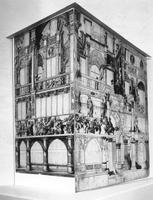
Model of the dance house in Basel
Hans Holbein the Younger
The Trial of St James (Scenes from the Life of St. James)
Andrea Mantegna
Scenes from the Life of St. James (reconstruction from coloured black-and-white photos)
Andrea Mantegna
Presentation of the Virgin
Domenico Ghirlandaio
The wise and foolish virgins
Tintoretto
Scenes from the Life of St. James
Andrea Mantegna
Slaughter of the Innocents
Domenico Ghirlandaio
Expulsion of Joachim
Domenico Ghirlandaio
April. Fresco in Palazzo Schifanoia (detail)
Francesco del Cossa
The Marriage of Alexander and Roxanne
Il Sodoma
St James Baptizing Hermogenes (Scenes from the Life of St. James)
Andrea Mantegna
St John the Baptist Preaching
Jacopo Bellini
Zacharias Writes Down the Name of His Son
Domenico Ghirlandaio
Scene from the Life of Moses (Scenes on the left)
Sandro Botticelli
St James Led to Execution (Scenes from the Life of St. James)
Andrea Mantegna
Virgin and Child with Saints
Mabuse
Decoration of the Sala del Gigli
Domenico Ghirlandaio
Scenes from the Life of St.Christopher
Andrea Mantegna
Marriage of Mary
Domenico Ghirlandaio
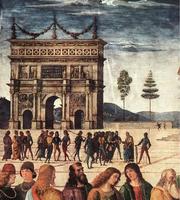
Christ Handing the Keys to St. Peter (detail 2)
Pietro Perugino