Análisis experto de A Shepherd Boy de Pietro Longhi
Estilo: Rococo · Género: genre painting
Expert Analysis of "A Shepherd Boy" by Pietro Longhi
Within the refined world of Rococo art—a style celebrated for its elegance, lightness, and playful charm—Pietro Longhi’s "A Shepherd Boy" stands as a quietly revolutionary work. While many Rococo painters turned their attention to aristocratic frolics, mythological allegories, or ornate pastoral fantasies, Longhi instead focused on the everyday life of ordinary Venetians. This painting exemplifies that shift, making it significant as a genre piece that grounds the Rococo aesthetic in humble reality.
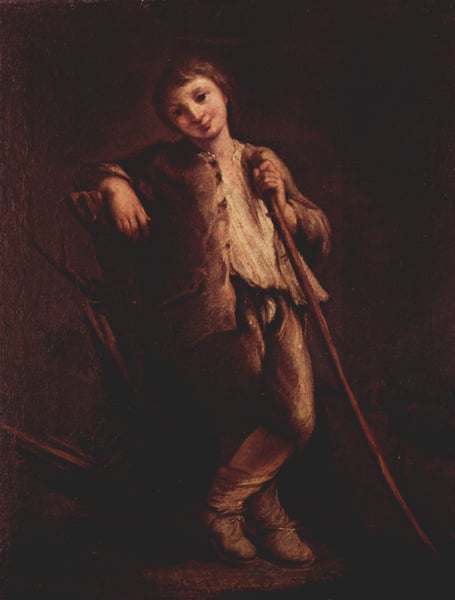
The work captures a single figure—a shepherd boy—in a candid, unheroic moment. There is no grand narrative or courtly masquerade; instead, Longhi presents a slice of life with gentle observation. The boy’s simple attire, his relaxed pose, and the intimate scale of the composition invite the viewer into a private world. This focus on the commonplace is exactly what distinguishes Longhi within the Rococo period: he turned the style’s characteristic lightness and decorative grace toward the lives of common people, offering a counterpart to the more ostentatious scenes of Watteau or Boucher.
What Makes It Significant in Its Style and Period
-
Democratizing the Rococo Eye: Longhi adapted the Rococo palette—soft pastels, delicate modeling, and atmospheric subtlety—to portray a shepherd, not a shepherdess in silks. This choice elevates genre painting to the same level of refinement as history painting, a subtle yet radical assertion that everyday Venetian life deserved the same artistic attention as mythology or court life.
-
A Window into 18th-Century Venice: As a genre painter, Longhi documented the social fabric of his city with an anthropological clarity. "A Shepherd Boy" likely reflects the pastoral traditions of the Venetian mainland (terraferma), where shepherds were a familiar sight. Yet Longhi avoids the sentimental idealization of many pastoral Rococo works; his boy is believable, not allegorical.
-
Contrast within Rococo: By focusing on a lone, humble figure, Longhi creates an intimate opposite to the crowded, festive scenes of contemporary Rococo masters. His work suggests that the Rococo spirit of grace and charm could be found not only in the boudoir or the fête galante but also in the quiet dignity of a working boy.
In sum, "A Shepherd Boy" is significant because it redefines Rococo genre painting: it is a delicate, observant portrait of ordinary life, proving that the period’s lightness and elegance could embrace the unadorned world with equal beauty. Longhi’s work offers us a more grounded, human-scaled vision of the 18th century—one where a shepherd boy, simply being himself, becomes a subject worthy of art’s finest attention.
Museum / Gallery
Visualmente similares
20 obras con composición y paleta relacionadas
Young Italian Patriot in the Mountains
Camille Corot
The Court Dwarf, Don Franciso Lezcano called 'El Nino de Vallecas'
Diego Velazquez
A beggar boy with basket
Ivan Tvorozhnikov
Breton
Alexandre Antigna
Going to Market
John Graham-Gilbert
Karl Begas Jr. as a Child
Carl Joseph Begas
Fernand Corot, the Painter s Grand Nephew, at the Age of 4 and a Half Years
Camille Corot
Alfred Dedreux as a Child
Théodore Géricault
Francesco Ravai, Known as 'Baiocco'
David Allan
The Drinker
Adriaen Brouwer
Old Man
Georges de la Tour
Boy with a Dog
Bartolome Esteban Murillo
Interior Scene (study for 'Fiddling His Way')
Eastman Johnson
Bubbles
John Everett Millais
The Smoker
Adriaen Brouwer
Italian shepherd boy
Peder Severin Kroyer
A Girl with a Broom
Rembrandt
Shepherd boy from Abruzzo
Filippo Palizzi
The Duel
August von Pettenkofen
Saint Isidore 'labrador
Juan van der Hamen