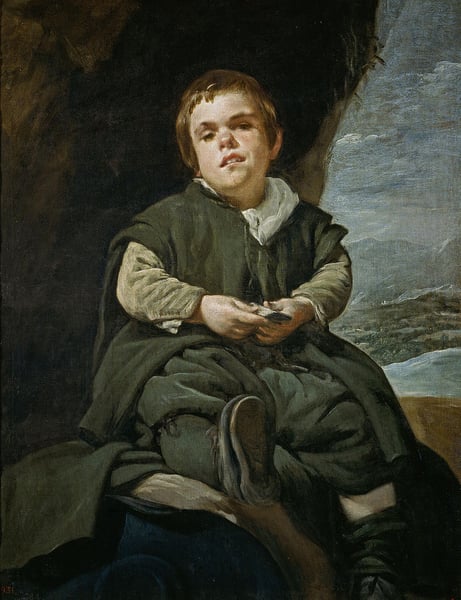
The Court Dwarf, Don Franciso Lezcano called 'El Nino de Vallecas'
Details
Expert analysis of Diego Velazquez’s The Court Dwarf, Don Franciso Lezcano called 'El Nino de Vallecas'
Style: Baroque · Genre: portrait
Analysis of "The Court Dwarf, Don Francisco Lezcano Called 'El Niño de Vallecas'" by Diego Velázquez
This work is a striking example of Baroque portraiture, a genre that Velázquez redefined through psychological depth and unflinching naturalism. The painting depicts Don Francisco Lezcano, a court dwarf with intellectual disabilities, yet Velázquez elevates him beyond stereotype.
Significance within the Baroque period:
- Humanization of marginalized subjects: Unlike earlier portrayals of dwarfs as mere curiosities or comic relief, Velázquez treats Lezcano with empathetic realism. The sitter’s direct gaze and dignified posture assert his individuality—a hallmark of Baroque interest in capturing human vulnerability and inner life.
- Tenebristic lighting: The strong chiaroscuro (a signature Baroque technique) sculpts Lezcano’s features, emphasizing both his physical distinctiveness and his quiet melancholy. The dark background isolates the figure, forcing the viewer to confront his humanity without distraction.
- Subversion of courtly conventions: While royal portraits of the era idealized power, Velázquez’s court dwarf portraits reveal the Spanish Habsburg court’s inclusivity of “monstrous” bodies—but with a compassionate, almost philosophical lens. Lezcano’s toy (a playing card or rattle) hints at his mental state, yet the painting refuses to reduce him to a symbol.
Significance as a portrait:
- The work challenges the traditional hierarchy of portraiture by giving a marginalized individual the same solemnity reserved for kings. Velázquez’s loose, confident brushwork (visible in the ruff and jacket) conveys texture and presence, while the careful modeling of the face captures a fleeting expression—both innocence and guardedness.
- It exemplifies Baroque naturalism: no idealized beauty, but a raw, honest depiction of a specific person. This approach influenced later artists who sought to depict the full spectrum of human experience.
In sum, the painting is significant for its humanistic innovation within Baroque portraiture—using the style’s dramatic tools not to glorify power, but to immortalize the dignity of a vulnerable soul.
Museum / Gallery
Visually similar
20 works with related composition and palette
Boy with a Dog
Bartolome Esteban Murillo
Karl Begas Jr. as a Child
Carl Joseph Begas
Zwei Kinder Bei Der Mahlzeit
Jan Miense Molenaer
Portrait of a Child with a Dog
Marten van Mytens the Younger
Boy Holding a Book (portrait of Lorenzo Tiepolo)
Giovanni Battista Tiepolo
A boy seated on a bench with a pitcher
William Henry Hunt
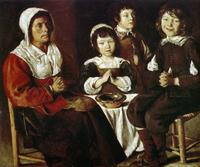
The grace
Le Nain brothers
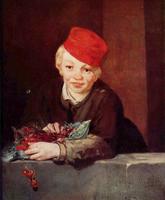
The Boy with Cherries
Edouard Manet
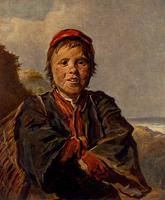
Fisher boy
Frans Hals
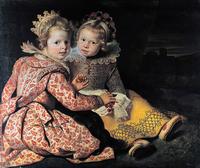
Magdalena and Jan-Baptist de Vos, Children of the Painter
Cornelis de Vos
Portrait of a Man with a Sheet of Music
Bernardo Strozzi
Children Eating a Pie
Bartolome Esteban Murillo
The Stewart Children (also known as Isabella and John Stewart)
Charles Willson Peale
Atherton Loring Jr. Age 6 of Boston's Duxbury, Massachusetts
Frank W. Benson
Lady Seated in a Window
Gabriel Metsu
A Shepherd Boy
Pietro Longhi
HALF LENGTH PORTRAIT OF ALAN ARCHIBALD CAMPBELL SWINTON
William Crawford
Fisher Boy
Frans Hals
Fisher Girl
Frans Hals
Portrait of a fat gentleman
Bernardo Strozzi