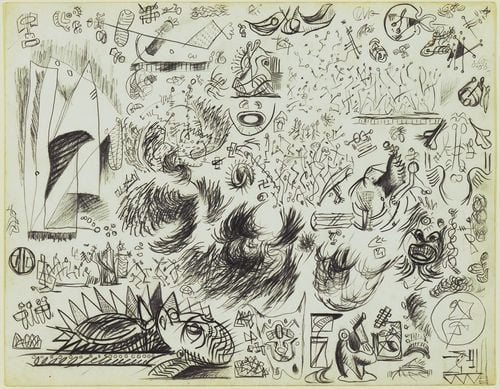
Sheet of Studies
Dettagli
Analisi esperta di Sheet of Studies di Jackson Pollock
Stile: Expressionism · Genere: figurative
Expert Art Historical Analysis: "Sheet of Studies" by Jackson Pollock
Jackson Pollock’s Sheet of Studies is a revealing early work that demonstrates the foundational figurative and expressionist discipline underpinning his later revolutionary abstract style. Created during his formative period, this piece belongs to Pollock’s pre-drip, figural phase—a crucial but often overshadowed chapter of his career.
Significance Within Expressionism and Pollock’s Development
While Pollock is famously celebrated for his all-over drip paintings, Sheet of Studies anchors his early practice in the European Expressionist tradition, particularly the gestural intensity of artists like Oskar Kokoschka and the psychological symbolism of Pablo Picasso’s 1930s work. Here, Pollock explores the human figure through rapid, energetic linework and darkened, compressed forms. The “studies” format—multiple sketches on a single sheet—reveals his methodical investigation of anatomy, posture, and emotional expression, all filtered through a raw, almost violent handling of charcoal or ink.
What Makes This Work Significant
-
A Bridge to Abstraction – Even in its figuration, the work exhibits Pollock’s signature restlessness. The figures are not static; they twist, bulge, and dissolve into surrounding marks. This dissolution of form anticipates his later “drip” period, where the figure is entirely replaced by rhythmic, all-over gesture. Sheet of Studies is thus a key document of his transition from representational to abstract expressionism.
-
Expressionist Emotional Charge – The exaggerated, contorted poses and heavy dark shading convey a sense of anxiety or primal energy, aligning with the Expressionist goal of channeling inner psychological states. This emotional directness would become a hallmark of Pollock’s mature style.
-
Technical Foundation – The sheet demonstrates Pollock’s command of line and mass, showing that his later abandonment of the figurative was a conscious choice rather than a lack of skill. He could render the human body with expressive power—and then chose to transcend it.
In summary, Sheet of Studies is essential for understanding Pollock’s artistic evolution. It reveals the figurative roots of his expressionism and the disciplined experimentation that would ultimately lead to his groundbreaking abstraction.
Museum / Gallery
Visivamente simili
20 opere con composizione e palette affini
Carnival Fiesta
Rene Portocarrero
Untitled (O'Connor-Thaw 770)
Jackson Pollock
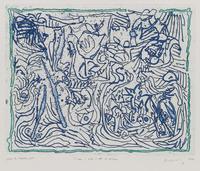
Bird's Eye View of the Sea (L'eau à vue d'oeil d'oiseau)
Pierre Alechinsky
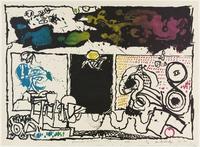
Discovery of Acid (Act I) [Découverte de l'acide (acte I)]
Pierre Alechinsky
Abst. 2 de 03
Jacques Wadier
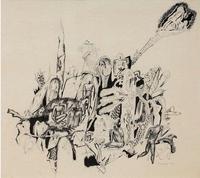
Primordial Scene
Walter Battiss
Rulle (Suggestions for the Cold War)
Oyvind Fahlstrom
Constellation: The Morning Star
Joan Miro
Number 14
Jackson Pollock
Bird in the Wind
Richard Pousette-Dart
Untitled
Houria Niati
Composición verde
Joan Ponc
Untitled
Vasile Kazar
Bantama
Rudolf Bauer
Discovery of Acid (Act II) [Découverte de l'acide (acte II)]
Pierre Alechinsky
Provincetown
Hans Hofmann
First abstract watercolor
Wassily Kandinsky
The Amazon unconscious
Pierre Alechinsky
Drawing for Capturing the Air
Constantin Flondor
Untitled
Joan Ponc