Expert analysis of Edvard Munch’s The Death Chamber
Style: Expressionism · Genre: genre painting
Expert Analysis of "The Death Chamber" by Edvard Munch
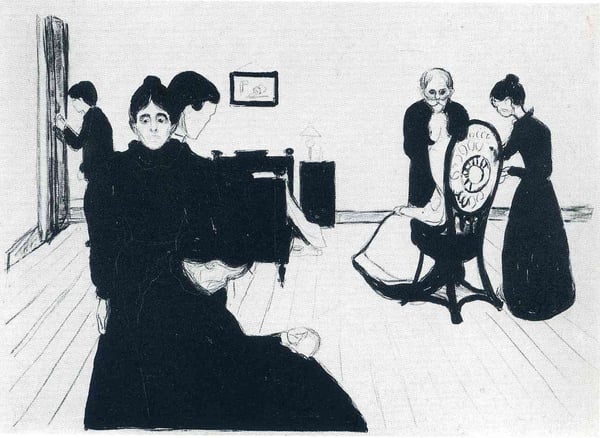
Edvard Munch’s The Death Chamber is a profound example of Expressionism within the broader European period, and it demonstrates the artist’s singular ability to transform a conventional genre painting—a scene of everyday life—into a vessel for intense psychological and emotional experience. While genre painting typically documents domestic or social routines, Munch subverts the tradition by focusing on the universal yet deeply personal moment of death.
What makes this work significant within its style and period is its radical departure from naturalistic representation. Munch distorts perspective, simplifies forms, and employs jarring color contrasts not to depict a literal room, but to convey the raw anguish and claustrophobia of a family gathered around a deathbed. The figures, with their elongated, mask-like faces, are not individualized portraits but archetypes of grief and dread. The space itself feels suffocating, with tilted floors and compressed walls that mirror the emotional collapse of the scene.
In the context of European Expressionism—a movement that flourished in the early 20th century and prioritized inner truth over outer reality—The Death Chamber stands as a landmark. It captures Munch’s lifelong obsession with mortality, anxiety, and the fragility of human bonds, themes that resonate through his entire oeuvre. Unlike earlier genre paintings that might romanticize or moralize about death, Munch’s work offers no comfort; it immerses the viewer in the raw, unmediated experience of loss. This fusion of a humble genre subject with the heightened, distorted language of Expressionism marks The Death Chamber as a pivotal piece, illustrating how Munch helped redefine painting as a direct conduit for the subconscious and the emotional turmoil of modern life.
Visually similar
20 works with related composition and palette
The two sisters
Edouard Vuillard
The Death of Nana
Charles Demuth
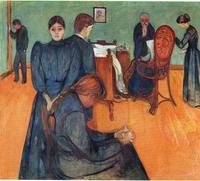
Death in the sickroom
Edvard Munch
The Beach at Trouville
Eugene Boudin
Studio Party
Florine Stettheimer
Gossip
Felix Vallotton
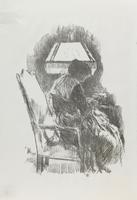
Mrs. Hassam Knitting
Childe Hassam
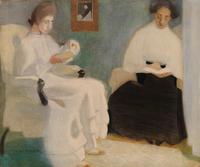
Girls Reading
Helene Schjerfbeck
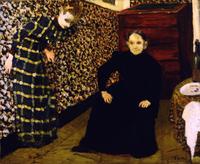
Interior with mother and sister of the artist
Edouard Vuillard
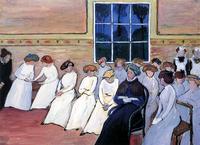
Women's boarding house
Marianne von Werefkin
Three Sisters with An African Sculpture
Henri Matisse
La Goulue and Paul Lescau
Henri de Toulouse-Lautrec
Portrait of My Teacher, Fräulein Sophie Von Prieser
Florine Stettheimer
At the Moulin de la Galette
Pierre-Auguste Renoir
Portrait of his daughter
Henri Matisse
Varró Nő
Bela Kadar
The Thread
Edouard Vuillard
Blue Dress in Ocher Armchair
Henri Matisse
Berény Róbert, Eta Olvas 1928
Berény Róbert
Doche - original drawing
Theophile Steinlen