Expert analysis of Edvard Munch’s The Sun
Style: Expressionism · Genre: landscape
Expert Analysis of "The Sun" by Edvard Munch
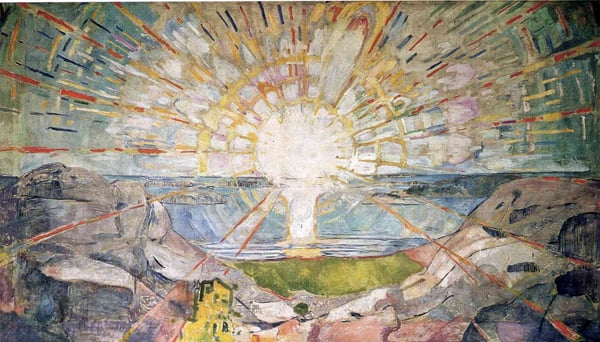
Edvard Munch’s "The Sun" (c. 1910–1916) is a monumental landscape that marks a transformative shift in his late-career output, embodying a more optimistic and universal expressionism. While Munch is best known for the tormented psychological states of works like The Scream, this painting represents a departure into cosmic awe and spiritual renewal.
Significance within Expressionism:
As an expressionist work, "The Sun" prioritizes emotional and symbolic resonance over naturalistic representation. Munch employs bold, radiating bands of yellow, orange, and white that burst outward from a central orb, set against a dark blue shoreline and still water. The painting’s schematic composition—a stark horizon line dividing earth from light—amplifies the elemental power of dawn. The sun becomes a primal force, not merely a landscape feature but an emblem of life, energy, and transcendence. This aligns with expressionism’s goal of externalizing inner feeling; here, the emotion is not anxiety but ecstatic reverence.
Context in Munch’s Late Works:
During his later period, Munch moved away from the intimate, often morbid narratives of his earlier symbolist phase. He turned to larger, more public commissions and a renewed engagement with nature. "The Sun" was originally painted for the Aula (ceremonial hall) of the University of Oslo, conceived as part of a series celebrating cosmic and human cycles. Its scale (over 4.5 meters wide) and open, luminous palette signal a shift toward monumental optimism. The work lacks the distorted figures and claustrophobic spaces of his earlier years; instead, it presents a calm, ordered universe where light dominates.
Genre and Stylistic Innovation:
Though categorized as a landscape, "The Sun" transcends traditional landscape painting. It abstracts the natural scene into a near-iconic emblem of radiant energy. Munch’s brushwork is both vigorous and deliberate: thick impasto strokes create the sun’s rays, while the foreground is rendered with smoother, darker passages. This contrast enhances the sensation of light emerging from darkness, a metaphor for enlightenment or rebirth. The painting anticipates later expressionist and even abstract approaches to color and form, where a single natural phenomenon becomes a vehicle for profound emotional statement.
Conclusion:
"The Sun" is significant as a culminating work of Munch’s career, demonstrating that expressionism could encompass not only angst but also ecstasy and cosmic unity. It marks his evolution from a painter of private torment to one of public, universal symbolism, and remains a masterful example of how landscape can be transformed into an enduring symbol of hope and vitality.
Museum / Gallery
Visually similar
20 works with related composition and palette
Chud has gone under the ground
Nicholas Roerich
Rocks at Pouldu
Maurice Denis
Scene from Mývatnssveit in North Iceland
Asgrimur Jonsson
Passing Train
Albert Bloch
Ploumanac'h
Henri Le Fauconnier
Final journey
Nicholas Roerich
Hymn (II)
Mikalojus Konstantinas Ciurlionis
Winter
Albert Bloch
The Sunken Cathedral
Sirak Skitnik
Angels Appearing before the Shepherds
Henry Ossawa Tanner
Orpheus Returns from the Pursuit of Eurydice
Henri Martin
Blue Waterfall
Albert Bloch
Shahdag
Sattar Bahlulzade
Sonnenuntergang Auf Der Mendel
Albin Egger-Lienz
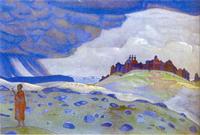
Procopius the Righteous removes a cloud of stone from the Great Ustyug
Nicholas Roerich
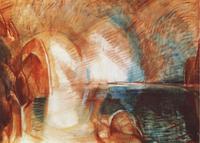
Egry József, Isola Bella
Egry József
Set Design prologue to the staging of Satan's Diary (by L. Andreev)
Kuzma Petrov-Vodkin
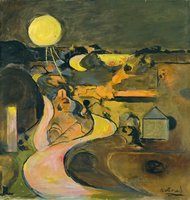
Road to Porthclais with Setting Sun
Graham Sutherland
The City on the Hill
Georges Braque
Thinking
Nicholas Roerich