
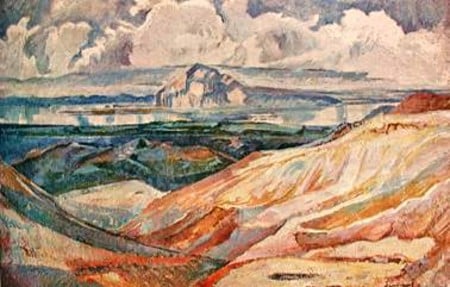
Analisi esperta di Scene from Mývatnssveit in North Iceland di Asgrimur Jonsson
Stile: Post-Impressionism · Genere: landscape
Expert Art Historical Analysis: Scene from Mývatnssveit in North Iceland by Ásgrímur Jónsson
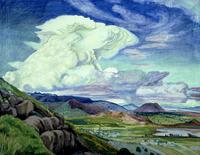
Ásgrímur Jónsson’s Scene from Mývatnssveit in North Iceland stands as a pivotal work within both Post-Impressionism and the history of Icelandic painting. Created by the artist widely regarded as the father of Icelandic modernism, this landscape exemplifies how Jónsson fused the expressive, color-driven principles of Post-Impressionism with the distinct topography and atmospheric character of his native country.
Significance within Post-Impressionism
As a Post-Impressionist piece, the painting moves decisively away from the naturalistic depiction of light and color that defined Impressionism. Instead, Jónsson employs heightened, often arbitrary color choices and structured, rhythmic brushwork to convey emotional and spiritual resonance rather than optical accuracy. In Scene from Mývatnssveit, the vivid blues of the lake and sky, the deep greens of the tundra, and the warm browns of the volcanic soil are intensified beyond reality. This use of symbolic, emotive color—reminiscent of the works of Paul Gauguin or Vincent van Gogh—transforms the landscape into an expression of Iceland’s raw, sublime beauty and the artist’s personal response to it. The composition is carefully organized, with strong diagonal lines from the shore and mountains guiding the eye through the scene, demonstrating Post-Impressionism’s concern with structure and form over fleeting impressions.
Significance in Icelandic Art and Culture
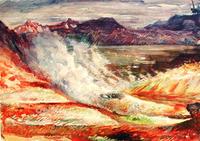
Jónsson’s work is crucial because it introduced Post-Impressionist ideals to Iceland, a country whose artistic tradition had long been rooted in Romantic, topographical, and documentary landscape painting. By applying modern European techniques to Icelandic subject matter, Jónsson created a national visual language that was both contemporary and authentically local. Scene from Mývatnssveit in North Iceland specifically captures the Mývatn region—a geothermally active, stark, and majestic area characterized by its volcanic formations, lake, and unique light. Jónsson’s interpretation elevates this specific locale from mere natural record to a poetic, almost mythic symbol of Icelandic identity. The painting’s significance lies in its successful marriage of the subjective, expressive freedom of Post-Impressionism with the rugged, untamed spirit of the Icelandic landscape. It marks a turning point where Icelandic art embraced modernity while celebrating its heritage, making Jónsson a foundational figure for subsequent generations of Nordic modernist painters.
In summary, Scene from Mývatnssveit in North Iceland is not merely a landscape but a landmark—a declaration that Iceland could be a subject for avant-garde artistic exploration, and that Post-Impressionism could thrive far beyond its French origins, enriched by the unique geography and light of the North Atlantic.
Visivamente simili
20 opere con composizione e palette affini
Delphi
Konstantinos Maleas
The Sun
Edvard Munch
Winter landscape
Nicholas Roerich
The Dead Sea, Jordan
Edward Lear
Sketch for a mural 'Crimea'
Konstantin Bogaevsky
Lake View
Basuki Abdullah
Winter Sun in Hafnarfjörður
Asgrimur Jonsson
Dune Landscape
Piet Mondrian
Thinking
Nicholas Roerich
Hills at Great Bear Lake
A.Y. Jackson
Mt. Námafjall in N.-Iceland
Asgrimur Jonsson
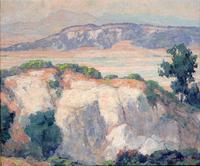
Torrey Pines
Maurice Braun
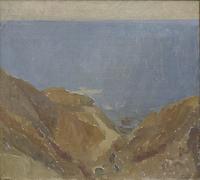
Seascape
Horace Trenerry
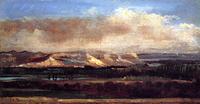
The Saleve Cliffs near Geneva
Theodore Rousseau
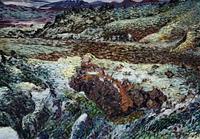
Svínahraun Lava Field
Johannes Sveinsson Kjarval
Morocco
Nicholas Roerich
Final journey
Nicholas Roerich
Island Borgøya
Lars Hertervig
Cloud over the mountain valley
Arkhyp Kuindzhi
La Nube
Dr. Atl