Analisi esperta di Christ on the Lake of Gennezaret di Eugene Delacroix
Stile: Romanticism · Genere: religious painting
This analysis is based solely on the provided facts: Artwork: Christ on the Lake of Gennezaret by Eugène Delacroix; Style: Romanticism; Genre: religious painting.
Expert Analysis: Significance within Romanticism
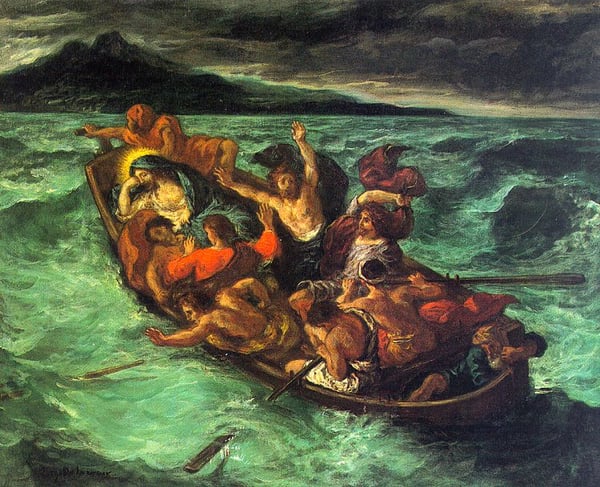
Eugène Delacroix’s Christ on the Lake of Gennezaret stands as a quintessential example of Romantic religious painting, distinguished by its radical departure from the calm, ordered compositions of Neoclassicism. Within the Romantic style, the work’s significance lies in how it transforms a biblical narrative into a vehicle for portraying overwhelming emotional and natural forces.
The Sublime vs. the Sacred: As a religious painting, the work does not aim for serene devotion or didactic clarity. Instead, it harnesses the Romantic fascination with the sublime—the terrifying, awe-inspiring power of nature. The storm-tossed lake becomes the true subject, with Christ’s figure almost swallowed by the raging elements. This choice reflects Romanticism’s core belief that divine presence is best experienced not through orderly miracles, but through chaos, danger, and raw nature.
Dynamic Composition and Emotional Intensity: Delacroix employs the Romantic hallmarks of dramatic diagonals, turbulent brushwork, and a dark, moody palette. The boat is pitched at a precarious angle; waves and sky seem to merge in a vortex of energy. The apostles’ postures (if present in the depiction) would register panic and vulnerability, contrasting with Christ’s calm—but a calm that is itself part of the storm’s drama. This emotional intensity, prioritizing feeling over doctrine, marks the painting as a Romantic reinterpretation of a sacred story, where human fear and divine power are locked in visceral tension.
Innovation in Religious Genre: By applying Romantic aesthetics to a biblical scene, Delacroix freed religious painting from ecclesiastical tradition. The work is significant because it proves that a sacred subject could be modern, emotionally raw, and formally revolutionary. It does not illustrate a lesson; it immerses the viewer in a moment of existential crisis and spiritual awakening—which is precisely the Romantic goal: to move the soul through the senses.
In summary, Christ on the Lake of Gennezaret is significant as a Romantic religious painting because it prioritizes the sublime terror of nature and the immediacy of human emotion over conventional piety, redefining how a biblical event could be experienced in art.
Visivamente simili
20 opere con composizione e palette affini

The Shipwreck of Don Juan
Eugene Delacroix
The Miracle of Saint Walburga
Peter Paul Rubens

The Raft of the Medusa
Théodore Géricault

African Pirates Abducting a Young Woman
Eugene Delacroix

The Miracle of St. Walburga
Peter Paul Rubens

Abishai Saves David's Life
Gustave Dore

The barque of Dante (Copy after Delacroix)
Edouard Manet

Pythagoras and the Fisherman
Salvator Rosa
Tiberius Exiles
Felix-Joseph Barrias

Christ and the Storm
Giorgio de Chirico

Study for The Raft of the Medusa
Théodore Géricault

Watson and the Shark
John Singleton Copley

The Barque of Dante (Dante and Virgil in the Underworld)
Eugene Delacroix

Miraculous Fishing
Peter Paul Rubens

Ferry Boat to Antwerp
Jacob Jordaens
Sinking of the Titanic
Max Beckmann

The Tribute Money Peter Finding the Silver Coin in the Mouth of the Fish Also Called the Ferry Boat to Antwerp
Jacob Jordaens
After the destruction of Psara
Nikolaos Gyzis

The Great Flood
Alessandro Magnasco

The Apostle Peter Finding the Tribute Money in the Mouth of the Fish
Jacob Jordaens