
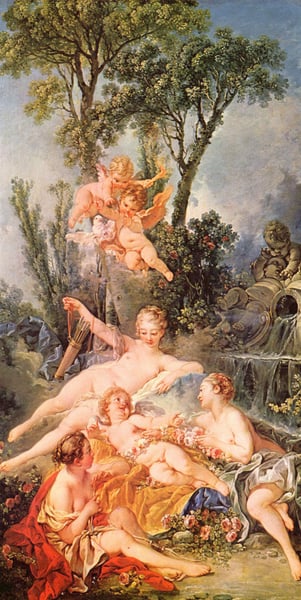
Analisi esperta di Amor a prisoner di Francois Boucher
Stile: Rococo · Genere: mythological painting
As an expert art historian, I will analyze "Amor a Prisoner" by François Boucher based solely on the provided facts: it is a Rococo mythological painting.
Analysis and Significance:
François Boucher’s "Amor a Prisoner" is a quintessential example of the Rococo style, which dominated French art in the mid-18th century. The painting’s significance lies in how it perfectly embodies Rococo’s defining characteristics: a lighthearted, playful approach to classical subject matter, a deliberate departure from the grandeur of Baroque, and an emphasis on decorative elegance and sensual charm.
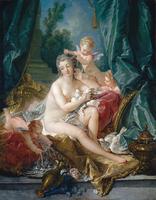
As a mythological painting, the work would typically draw on classical allegory—here, the capture or imprisonment of Cupid (Amor), the god of love. However, Boucher transforms this traditional theme into a frivolous, almost theatrical tableau. Rather than a serious moral or heroic narrative, the scene is likely filled with soft, pastel hues, delicate flesh tones, and a sinuous, fluid composition. The “prisoner” concept would be treated not as a violent capture but as a coy, playful seduction, with putti or nymphs teasingly binding the god of love. This aligns perfectly with Rococo’s celebration of love, pleasure, and intimacy among the aristocracy.
Boucher’s significance within the Rococo period is underscored by his mastery of texture and surface elegance. His mythological figures are often porcelain-like, with idealized, rosy bodies and coquettish expressions that invite the viewer into a world of refined sensuality. “Amor a Prisoner” showcases his ability to merge classical allusion with contemporary aristocratic tastes, creating a decorative yet intellectually playful work. The painting would have been intended for a private boudoir or salon, reinforcing Rococo’s role as an art of private enjoyment rather than public statement.
In summary, “Amor a Prisoner” is significant because it epitomizes Rococo’s transformation of mythological painting from a vehicle for moral instruction into a vehicle for visual delight, erotic innuendo, and graceful artifice—a hallmark of Boucher’s influential career and the taste of pre-Revolutionary France.
Visivamente simili
20 opere con composizione e palette affini
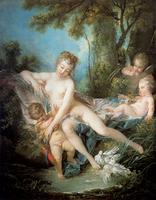
Venus comforts Amor
Francois Boucher
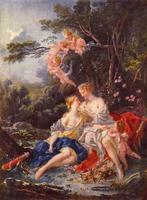
Jupiter and Callisto
Francois Boucher
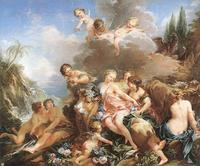
The Rape of Europa
Francois Boucher
Abundance and the Four Elements
Jan Brueghel the Elder
Allegory of the Vices
Correggio
Nymphs and Bacchantes paying homage at the temple of Flora
Gerard de Lairesse
The Bathers
Jean-Honore Fragonard
Nymphs and Satyrs
Peter Paul Rubens
Apollo and Daphne
Jean-Baptiste van Loo
Apollo Revealing his Divinity to the Shepherdess Isse
Francois Boucher
Diana getting out of her bath
Francois Boucher
The Copper Age
Pietro da Cortona
Leda and the Swan
Francois Boucher
Cymon and Iphigenia
Frans Snyders
Mars and Venus
Nicolas Poussin
The Birth and Triumph of Venus
Francois Boucher
Cupid and Psyche
Anthony van Dyck
Pan and Syrinx
Francois Boucher
Diana and Callisto
Peter Paul Rubens
The Toilet of Venus
Francois Boucher