Expert analysis of Wassily Kandinsky’s Black and Violet
Style: Abstract Art · Genre: abstract
Expert Analysis of Wassily Kandinsky’s Black and Violet (1923)
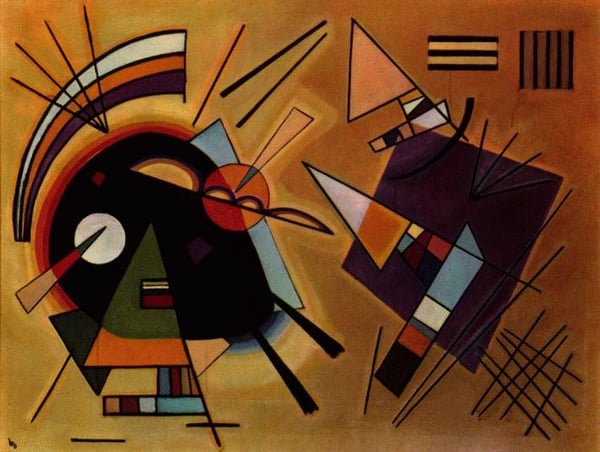
Within the canon of early 20th‑century abstraction, Wassily Kandinsky’s Black and Violet stands as a pivotal example of his mature, geometric phase—a period when he synthesized his earlier intuitive expressionism with the disciplined formal language he developed during his tenure at the Bauhaus.
Formal Language and Composition
The painting is dominated by intersecting planes, floating circles, and sharp diagonal lines, all set against a pale, atmospheric ground. Black and violet—the titular hues—are not merely colors but charged symbols in Kandinsky’s synesthetic vocabulary. Black, which he described as a “silent” color representing finality and the void, anchors the composition in the lower left, while violet—a mixture of restless red and calm blue—evokes a sense of mystical tension and transition. The geometry is deliberate yet dynamic; shapes appear to push and pull, creating a rhythm that mimics musical counterpoint—a direct application of Kandinsky’s theory that painting could achieve the same emotional resonance as music.
Significance within Kandinsky’s Oeuvre and Abstract Art
Black and Violet exemplifies Kandinsky’s shift from the turbulent, organic forms of his pre‑World War I work (e.g., Composition VII) toward a more calculated, “constructive” abstraction. Here, every line and color field serves a precise emotional and spiritual function, as outlined in his treatise Concerning the Spiritual in Art (1911). The painting’s significance lies in its demonstration that abstraction need not be chaotic; it can be rigorously ordered while still conveying profound inner experience. Kandinsky’s use of violet—a color he associated with “the emotional transition from earthly to cosmic consciousness”—highlights his enduring belief that art should transcend material reality to access the spiritual.
Historical Context
Created in 1923, at the height of the Bauhaus’s influence, Black and Violet reflects the school’s integration of art, craft, and theory. Kandinsky’s geometric vocabulary here parallels the work of his colleagues Paul Klee and Josef Albers, yet his unique fusion of theosophical mysticism with modernist structure remains distinctive. The painting is a landmark of non‑objective art, proving that color and form alone could generate meaning, emotion, and spiritual resonance—a legacy that would inform Abstract Expressionism and later movements.
Conclusion
Black and Violet is not merely an exercise in shape and hue; it is a manifesto of Kandinsky’s conviction that art’s highest purpose is to communicate the intangible. Its interplay of restraint and emotion, geometry and spirituality, makes it a cornerstone of Kandinsky’s Bauhaus period and a testament to abstraction’s capacity for intellectual depth and sensory power.
Visually similar
20 works with related composition and palette
Yellow-Red-Blue
Wassily Kandinsky
In Blue
Wassily Kandinsky
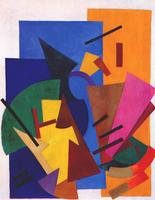
Flight of an Aeroplane
Olga Rozanova
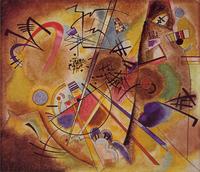
Small dream in red
Wassily Kandinsky
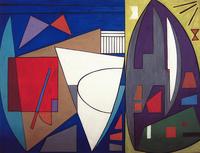
Doppio
Atanasio Soldati
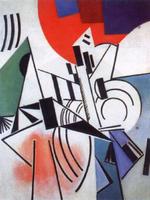
Suprematism
Olga Rozanova
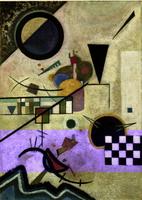
Contrasting sounds
Wassily Kandinsky
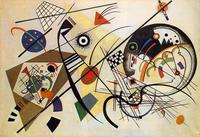
Transverse Line
Wassily Kandinsky
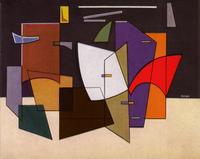
Allegro e fuga
Atanasio Soldati
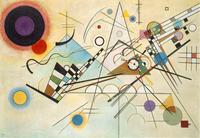
Composition VIII
Wassily Kandinsky
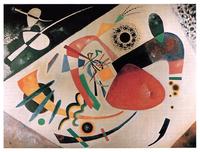
Red spot II
Wassily Kandinsky
Landscape
Georges Valmier
Pure Myth
Perle Fine
Vallée - nuit
Gustave Singier
The Window
Hans Hofmann
First Study for the Williamsburg Mural
Ilya Bolotowsky
Organization
Arshile Gorky
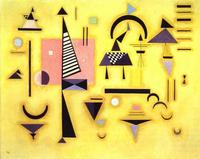
Decisive Pink
Wassily Kandinsky
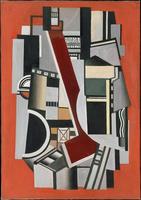
Mechanical Elements on red background
Fernand Leger
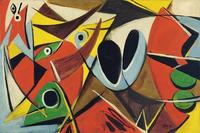
Mythe
Ernst Wilhelm Nay