
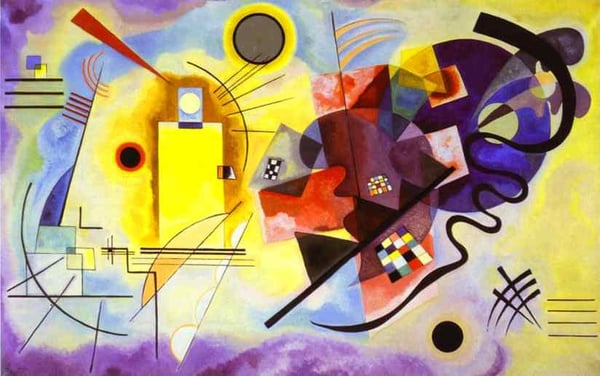
Yellow-Red-Blue
Details
Expert analysis of Wassily Kandinsky’s Yellow-Red-Blue
Style: Abstract Art · Genre: abstract
As an expert art historian, I can provide an analysis of Wassily Kandinsky's Yellow-Red-Blue based on its given classification as an Abstract Art work in the abstract genre. The painting is highly significant as a prime example of Kandinsky's mature, Bauhaus-period style, where he systematically explored the psychological and spiritual resonance of pure color and form.
Composition and Color Theory:
Kandinsky believed that colors and shapes could evoke specific emotions and spiritual vibrations, much like music. In Yellow-Red-Blue, he divides the canvas into two distinct halves: the left side is dominated by warm, active hues (yellow, red) and dynamic, angular forms; the right side shifts to cooler, passive tones (blue) with circular, floating elements. This deliberate opposition demonstrates his theory of "inner necessity"—the idea that artistic expression must come from the artist's soul rather than from visual reality. The stark, geometric shapes (lines, circles, rectangles) are not decorative but are meant to provoke an almost musical rhythm, aligning with his goal of creating a "pictorial language" independent of natural objects.
Significance within Abstract Art:
Created in 1925, this painting marks a pivotal moment in the development of abstract art. Kandinsky moved away from the looser, more improvisational abstractions of his earlier work (e.g., Composition VII) toward a stricter, more analytical geometry—a shift influenced by his teaching at the Bauhaus. Yellow-Red-Blue encapsulates his quest to balance intuition with structure, chaos with order. The primary colors (yellow, red, blue) are not used literally but as symbols of opposing forces: yellow represents earthly warmth and aggression, blue stands for spiritual depth and calm, while red bridges the two. This color triad was central to his treatise Concerning the Spiritual in Art, making the painting a visual manifesto of his theories.
Genre as Abstract:
As an abstract work, it rejects all recognizable subject matter, yet it is far from random. Every line and color patch serves a precise compositional purpose, resulting in a harmony that Kandinsky likened to the "cosmic order." The painting's significance lies in its demonstration that abstraction could be both emotionally expressive and intellectually rigorous, influencing generations of Abstract Expressionists and geometric abstractionists. In short, Yellow-Red-Blue is a cornerstone of early modern abstraction, showing how color and form alone can communicate profound meaning.
Museum / Gallery
Visually similar
20 works with related composition and palette
Black and Violet
Wassily Kandinsky
In Blue
Wassily Kandinsky

Con roso
Rudolf Bauer
First Study for the Williamsburg Mural
Ilya Bolotowsky
Small dream in red
Wassily Kandinsky
Contrasting sounds
Wassily Kandinsky
Cin-Zin
Karl Knaths
Transverse Line
Wassily Kandinsky
Untitled
Maurice Esteve
Untitled
Maurice Esteve
Yellow Predominance
Hans Hofmann
The Window
Hans Hofmann
Italian Landscape in 2073 BC
Carloluigi Colombo
Untitled
Constantin Blendea
La lanterne et le petit haricot
Le Corbusier
Mondo e uomo
Antonio Sanfilippo
Composition
Alexander Rodchenko
Composizione
Bice Lazzari
Man with a Guitar
Georges Braque
Suprematism
Olga Rozanova