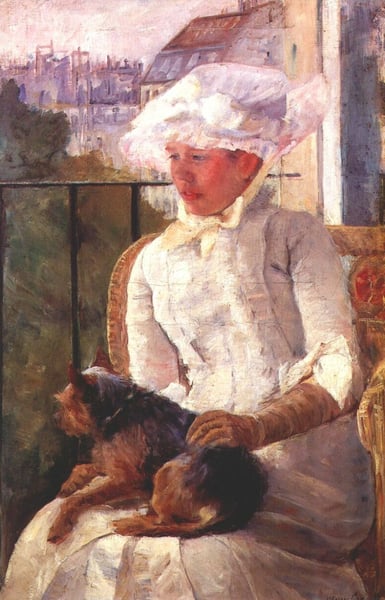
Analysis of "Susan on a Balcony Holding a Dog" by Mary Cassatt
As an Impressionist portrait, this work by Mary Cassatt exemplifies the movement’s radical departure from formal, studio-bound portraiture. Cassatt, one of the few female artists at the forefront of Impressionism, frequently focused on intimate, candid scenes of women in domestic or private settings. Here, the balcony setting merges interior with exterior space—a hallmark of Impressionist interest in capturing modern life and the fleeting effects of light and atmosphere. The inclusion of a dog not only personalizes the sitter but also underscores the informality that distinguishes Impressionist portraiture from its more rigid, posed predecessors. Though the specific visual details of this painting are limited in the supplied facts, its significance lies in Cassatt’s ability to infuse an everyday moment with psychological depth and compositional modernity, while also expanding the roles depicted for women beyond traditional allegorical or decorative subjects. This work stands as a testament to how Impressionism transformed portraiture into a vehicle for immediate, lived experience.