Barbarous Tales
Подробности
Экспертный разбор работы «Barbarous Tales» художника Paul Gauguin
Стиль: Post-Impressionism · Жанр: allegorical painting
Analysis of Paul Gauguin’s Barbarous Tales (Contes barbares)
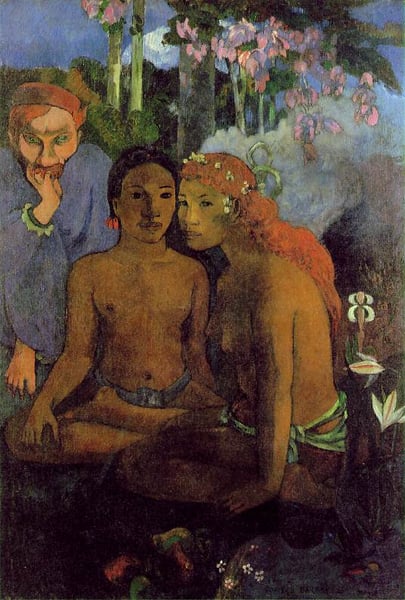
Paul Gauguin’s Barbarous Tales, created during his second and final Tahitian period (1895–1901), stands as a quintessential example of Post-Impressionism’s break with naturalism and its embrace of symbolic, subjective expression. Painted in 1902, the work is an allegorical composition that synthesizes Gauguin’s fascination with Polynesian mythology, his personal spiritual crisis, and his rejection of European bourgeois culture.
Significance within the Post-Impressionist Movement
Post-Impressionism sought to move beyond Impressionism’s fleeting effects of light and color, instead prioritizing emotional resonance, symbolic content, and formal structure. Gauguin achieved this through:
- Flat, non-naturalistic planes of color – vivid greens, ochres, and deep blues that evoke a dreamlike, timeless atmosphere rather than literal representation.
- Simplified, almost primitive forms – figures are rendered with heavy outlines and generalized features, deliberately echoing Oceanic carving and folk art.
- Compositional ambiguity – the arrangement of three Tahitian figures (two young women and a seated man) resists clear narrative, inviting the viewer into a ritualistic, indecipherable “barbarous” tale.
Allegorical Dimensions
The painting’s title suggests a story drawn from Tahitian legends or Gauguin’s own invented mythology. The figure on the left, with a white flower and upturned gaze, likely embodies a vahine (native woman) as a symbol of primal innocence. The central, crouching woman holds a fruit, alluding to temptation or the loss of Eden. The seated male figure, reminiscent of Gauguin’s self-portraits, could represent the artist-as-witness or a mythological trickster. This layered symbolism reflects Gauguin’s desire to create a universal allegory of life, desire, and mortality—a theme he explored in his earlier masterpiece Where Do We Come From? What Are We? Where Are We Going?
Second Tahiti Period Context
Gauguin returned to Tahiti in 1895 after a failed attempt to live in France, disillusioned by colonialism and the erosion of indigenous culture. His late works, including Barbarous Tales, become more deliberately “savage” in style, intensifying the use of bright, unmixed colors and deliberately “clumsy” proportions. This was not naivety but a calculated critique of Western artistic conventions. The painting’s rough, almost unfinished surface emphasizes its handmade, tactile quality, reinforcing the idea of primitivism as a corrective to industrialized modernity.
Enduring Significance
Barbarous Tales encapsulates the tension at the heart of Gauguin’s project: it celebrates Tahitian culture while unavoidably romanticizing it through a European lens. The work is a provocative fusion of allegory, autobiography, and exoticism, demonstrating Post-Impressionism’s power to transform local motifs into transcendent, often unsettling, visual poetry. Its bold formal choices would influence Fauvism and Expressionism, cementing Gauguin’s role as a bridge between 19th-century symbolism and 20th-century modernism.
Museum / Gallery
Визуально похожие
20 работ с близкой композицией и палитрой
Delectable Waters
Paul Gauguin
The Bathers
Paul Gauguin
And the Gold of Their Bodies
Paul Gauguin
Bathers
Paul Serusier
The King's Wife
Paul Gauguin
Adam and Eve
Paul Gauguin
Three Tahitian Women
Paul Gauguin
Untitled
Antonietta Raphael
Arearea I
Paul Gauguin
Two women (Flowered hair)
Paul Gauguin
Te Nave Nave Fenua (Delightful Land)
Paul Gauguin
Trinity evening
Maurice Denis
Are You Jealous?
Paul Gauguin
Two tahitian women
Paul Gauguin
Hina, Moon Goddess and Te Fatu, Earth Spirit
Paul Gauguin
Baptism
Marcel Duchamp
The Invocation
Paul Gauguin
Tahitian Man with His Arms Raised
Paul Gauguin
Group of nude figures in a forest
Paul Delvaux
Perfect days
Paul Gauguin