In the Vanilla Grove, Man and Horse (The Rendezvous)
Ayrıntılar
Paul Gauguin sanatçısının In the Vanilla Grove, Man and Horse (The Rendezvous) eseri hakkında uzman analizi
Tarz: Post-Impressionism · Tür: landscape
Expert Analysis of In the Vanilla Grove, Man and Horse (The Rendezvous) by Paul Gauguin
Significance within Post-Impressionism and Gauguin’s First Tahiti Period
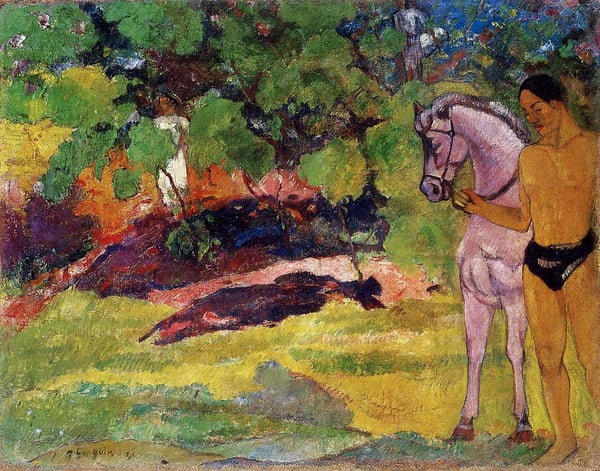
Paul Gauguin’s In the Vanilla Grove, Man and Horse (The Rendezvous) (1891) stands as a quintessential example of his first Tahitian period, a radical break from European naturalism that redefined Post-Impressionist landscape painting. Executed shortly after his arrival in Tahiti, the work embodies Gauguin’s quest for a “primitive” essence—a synthesis of observation, memory, and symbolic imagination.
Key Stylistic and Thematic Innovations
-
Synthetic Symbolism – Gauguin rejects Impressionist optical accuracy for flat, unmodulated fields of color. The vanilla grove is rendered in lush, almost decorative bands of green, yellow, and red, with the figures of a Tahitian man and his horse integrated into the landscape as archetypal presences rather than realistic actors. This flattening of space and suppression of perspective—a hallmark of his mature style—creates a dreamlike, ceremonial atmosphere.
-
Color as Emotion – The fiery oranges and deep greens are not naturalistic but emotional and symbolic. Gauguin uses color to evoke the sensuality and mystery of Tahiti, moving beyond local color toward a subjective, expressive palette. This anticipates the Fauves and later Expressionist movements.
-
Cultural Synthesis – The “rendezvous” title suggests a narrative encounter, but the painting resists clear storytelling. Gauguin blends Tahitian motifs (the horse, a colonial import; the figures’ quiet dignity) with a composition reminiscent of Japanese prints and medieval stained glass. This hybridization is crucial: Gauguin sought to capture a timeless, pre-industrial harmony, even as he imposed European pictorial structures onto Polynesian subject matter.
Why This Work Matters
In the Vanilla Grove exemplifies how Gauguin’s first Tahitian period transformed Post-Impressionism into a vehicle for symbolic meaning and cultural critique. By abandoning Western academic conventions for a “savage” simplicity—bold outlines, non-naturalistic color, and simplified forms—he opened the door to Primitivism in modern art. The painting is not merely a landscape but a manifesto: a vision of life unburdened by modern civilization, rendered through a style that itself embodies that escape. It remains a cornerstone for understanding Gauguin’s radical departure from Impressionism and his lasting influence on Picasso, Matisse, and early 20th-century modernism.
Museum / Gallery
Görsel olarak benzer
İlişkili kompozisyon ve renk paletine sahip 20 eser
The White Horse
Paul Gauguin
Flight
Paul Gauguin
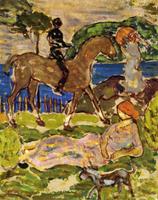
Idyllic Landscape
Maurice Prendergast
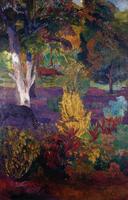
Marquesan landscape with horses
Paul Gauguin
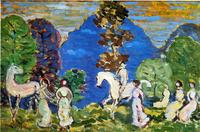
Rider against Blue Hills
Maurice Prendergast
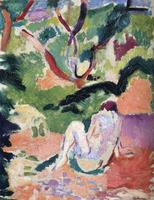
Nude in a Wood
Henri Matisse
Riders on the Beach II
Paul Gauguin
Zwei Badende Mädchen (mädchen Im Hemd)
Otto Mueller
Le Cheval Blanc
Jean Paul Lemieux
Bathing boys
Pyotr Konchalovsky
Playing Naked People
Ernst Ludwig Kirchner
Forest Scene with Colt
Istvan Ilosvai Varga
Zwei Im Wald Liegende Akte
Otto Mueller
Nacktes Mädchen Auf Baum
Otto Mueller
Bathers
Paul Serusier
Zwei Akte Am See
Otto Mueller
Women and white horse
Paul Gauguin
Coming and going, Martinique
Paul Gauguin
Struggle between Woman and Centaur
Odilon Redon
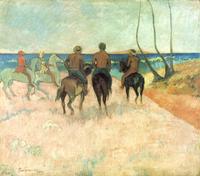
Riders on the Beach I
Paul Gauguin