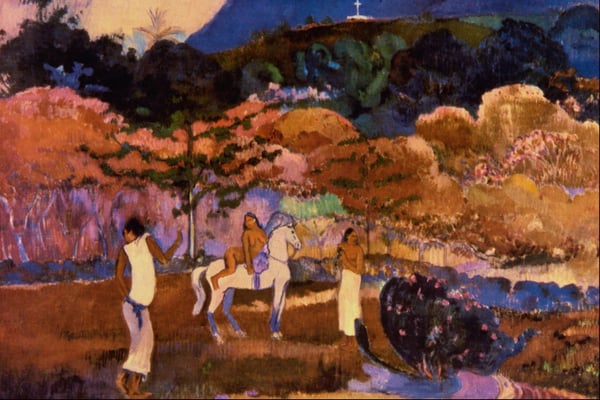
Women and white horse
Dettagli
Analisi esperta di Women and white horse di Paul Gauguin
Stile: Post-Impressionism · Genere: genre painting
Expert Analysis of Women and White Horse by Paul Gauguin
Paul Gauguin’s Women and White Horse, created during his second Tahitian period (1895–1901), exemplifies the artist’s radical departure from European naturalism toward a synthesized, symbolic vision of “primitive” life. Painted in the Post-Impressionist style, the work is a genre scene that transcends mere documentation, instead offering a dreamlike meditation on the harmony between humanity, nature, and the spiritual.
Significance within Post-Impressionism and Gauguin’s Tahitian Oeuvre:
-
Synthesis of observation and imagination – Gauguin did not paint Tahiti as it was, but as he idealized it: a timeless, prelapsarian world. The white horse, a recurring motif in his work, likely carries symbolic weight—possibly referencing themes of purity, freedom, or a bridge between the earthly and the mythical. The women are depicted with simplified, sculptural forms, their poses serene and unselfconscious, merging with the lush, patterned landscape.
-
Color as emotional and symbolic tool – Gauguin abandons local color for bold, non-naturalistic hues. The vivid greens, ochres, and blues are arranged in flat, unmodulated planes, creating a decorative, almost tapestry-like surface. This method—derived from cloisonnism and Japanese prints—prioritizes emotional resonance over optical accuracy, a hallmark of Post-Impressionist innovation.
-
Rejection of Western perspective and depth – The shallow space, with figures and trees compressed into a frieze-like arrangement, flattens the picture plane. This deliberate “primitivism” challenges Renaissance conventions, aligning Gauguin with artists like Cézanne and van Gogh who sought to restructure pictorial space.
-
Cultural context and ambivalence – Painted during Gauguin’s self-imposed exile in Tahiti, the work embodies his longing for a “lost” Eden, but also reflects the colonial gaze. The women’s passive, tranquil poses and the inclusion of the horse (an animal introduced by Europeans) subtly reveal the artist’s romanticized view, as well as the inevitable cultural hybridity of the South Pacific.
In Women and White Horse, Gauguin achieves a synthesis of decorative abstraction, symbolic content, and ethnographic observation that would profoundly influence Fauvism, Expressionism, and early Modernism. It stands as a key example of his late style—bold, enigmatic, and deeply subjective—where the line between reality and myth blurs into a timeless, poetic vision.
Museum / Gallery
Visivamente simili
20 opere con composizione e palette affini
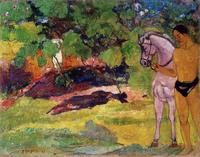
In the Vanilla Grove, Man and Horse (The Rendezvous)
Paul Gauguin
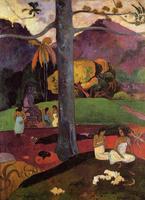
Olden times
Paul Gauguin
Blue mountain
Wassily Kandinsky
Marquesan landscape with horses
Paul Gauguin
Family
Grégoire Michonze
Tahitian mountains
Paul Gauguin
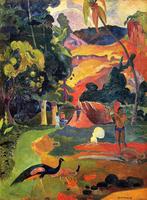
Landscape with peacocks
Paul Gauguin
Berény Róbert, Gyümölcs Szedők
Berény Róbert
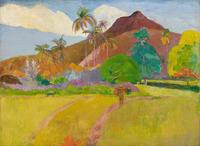
Tahitian Landscape
Paul Gauguin
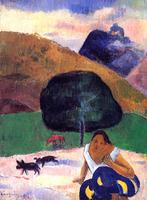
Landscape with black pigs and a crouching Tahitian
Paul Gauguin
Flight
Paul Gauguin
Rider against Blue Hills
Maurice Prendergast
Road in Tahiti
Paul Gauguin
Berény Róbert, Pihenő Fiú,
Berény Róbert
Untitled
Marianne von Werefkin
View of monte Acuto
William Balthazar Rose
The Invocation
Paul Gauguin
Women at the riverside
Paul Gauguin
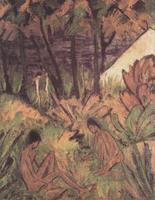
Badende Am Waldsee
Otto Mueller
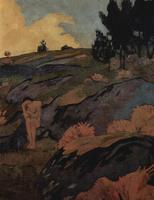
Melancholia, or Breton Eve
Paul Serusier