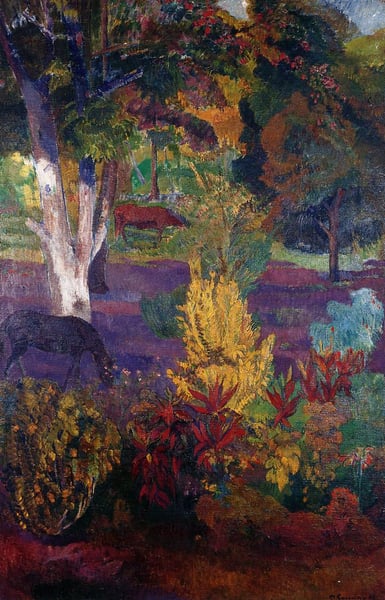
Marquesan landscape with horses
Détails
Analyse experte de Marquesan landscape with horses de Paul Gauguin
Style : Post-Impressionism · Genre : landscape
This analysis focuses on the significance of Paul Gauguin's Marquesan landscape with horses within the context of Post-Impressionism and his second Tahiti period.
Expert Analysis: Marquesan landscape with horses by Paul Gauguin
As a quintessential work from Gauguin's second Tahiti period (often extended to include his final Marquesan sojourn), Marquesan landscape with horses exemplifies the artist's mature Post-Impressionist vision. Its significance lies not in topographical accuracy but in how Gauguin synthesizes observed reality with symbolic, decorative, and emotional expression.
1. Transition into Symbolic Landscape: During this late period, Gauguin moved away from the narrative subjects of his earlier Tahitian works (e.g., Where Do We Come From?). Here, the landscape itself becomes the primary carrier of meaning. The horses—animals introduced by Europeans—are integrated into a scene that feels both primal and timeless. This fusion of foreign and indigenous elements reflects Gauguin's complex, idealized vision of "primitive" life.
2. Post-Impressionist Formal Innovation: The work is significant for its radical departure from naturalistic perspective and color. True to Post-Impressionism, Gauguin flattens spatial depth, using bold outlines and unmodulated areas of pure, often non-naturalistic color. The ground is painted in vivid reds, oranges, or yellows, while foliage is rendered in dark silhouettes. This "cloisonnism" (inspired by stained glass and Japanese prints) prioritizes emotional impact over optical realism.
3. Synthesis of Local and Universal: The Marquesas were the final stop in Gauguin's search for an unspoiled Eden. In this landscape, the horses are typically depicted in a calm, frieze-like arrangement, almost as part of the earth itself. They are not simply animals but symbols of a harmonious, pre-industrial existence. The work thus stands as a late testament to Gauguin's central Post-Impressionist goal: to express the spiritual and mysterious essence of a place through abstracted, poetic forms.
In sum, Marquesan landscape with horses is significant as a prime example of Gauguin's final artistic phase, where landscape became a vehicle for pure, symbolic expression—a key legacy of Post-Impressionism.
Museum / Gallery
Visuellement similaire
20 œuvres à la composition et à la palette proches
Vaszary János, Tatai Parkrészlet 1910
Vaszary János
Landscape with Horses
Pierre-Auguste Renoir
The boy in the park
Pyotr Konchalovsky
Coming and going, Martinique
Paul Gauguin
Landscape with three trees
Paul Gauguin
Forest Scene with Colt
Istvan Ilosvai Varga
Orchard
Paul Cezanne
Landscape with two goats
Paul Gauguin
Two cows in the meadow
Paul Gauguin
Fruit Trees
Claude Monet
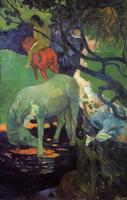
The White Horse
Paul Gauguin
Paysage, sketch to the "Strange garden"
Józef Mehoffer
Study for 'In the Woods with Female Nude
Henri-Edmond Cross
Landscape at Ladyzhino
Natalia Goncharova
Landscape
Joaquín Sorolla
Toulouse Landscape
Henri Matisse
Trivaux Pond
Henri Matisse
Glimpse of the countryside with trees
Angelo Morbelli
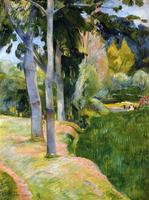
The large tree
Paul Gauguin
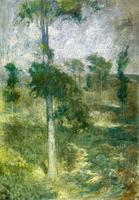
Tulip Tree, Greenwich
John Henry Twachtman