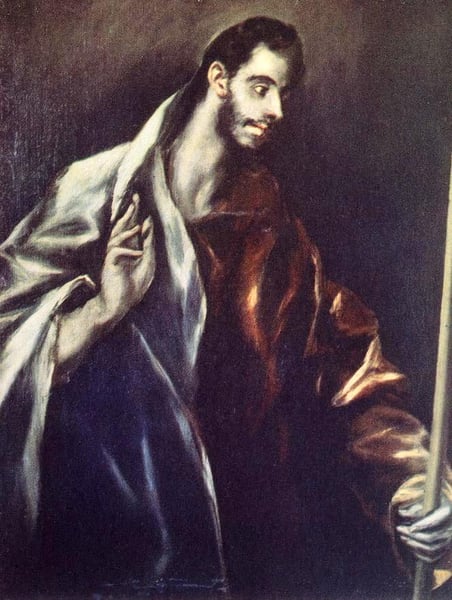
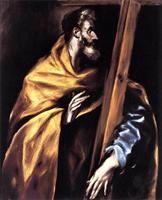
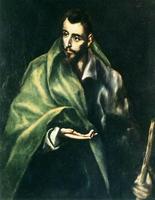
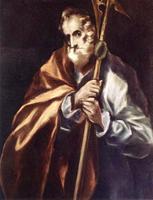
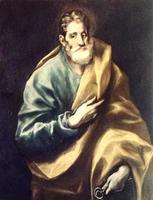
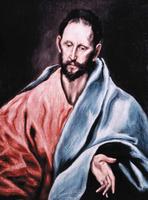
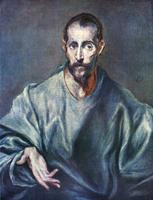
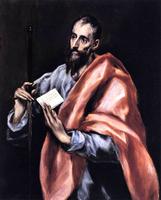
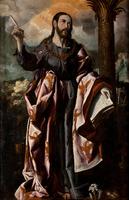
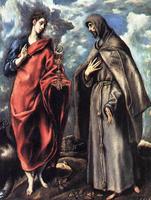
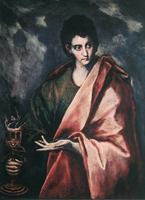
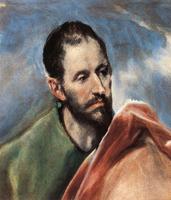
El Greco’s Apostle St. Thomas stands as a quintessential example of Mannerist religious painting from his Spanish period, demonstrating the artist’s radical departure from High Renaissance naturalism toward a style defined by heightened emotional expression and spiritual intensity. Painted during his mature years in Toledo, the work exemplifies Mannerism’s characteristic elongation of form and dramatic distortion—St. Thomas’s figure is stretched into an elegant, almost otherworldly silhouette, his limbs and torso lengthened to convey a sense of divine grace rather than anatomical accuracy. The composition is taut with psychological tension: the saint’s gaze is introspective, his hand perhaps gesturing toward the wound of Christ (a reference to his doubting nature), while the background suppresses spatial depth, forcing the figure forward into a charged, iconic presence. El Greco’s palette—cool, acidic tones of grey-green and pale pink contrasted with stark highlights—creates a flickering, spiritual luminescence that seems to emanate from within the figure itself, a hallmark of his Spanish period that merges Byzantine iconographic tradition with the vivid chiaroscuro of Venetian Mannerism. The work’s significance lies in how it transforms a conventional apostolic portrait into a vehicle for Counter-Reformation piety: the saint’s elongated, weightless form and the unnerving, non-naturalistic light suggest a soul already transfigured by faith, prioritizing inner vision over earthly reality. This painting encapsulates El Greco’s role as a Mannerist visionary, whose idiosyncratic style became a powerful tool for conveying the mystical fervor of Spanish Catholicism, setting his work apart from the more restrained religious art of his contemporaries.