Analisi esperta di Christ healing the blind man di El Greco
Stile: Mannerism (Late Renaissance) · Genere: religious painting
Expert Analysis: “Christ Healing the Blind Man” by El Greco (Cretan Period)
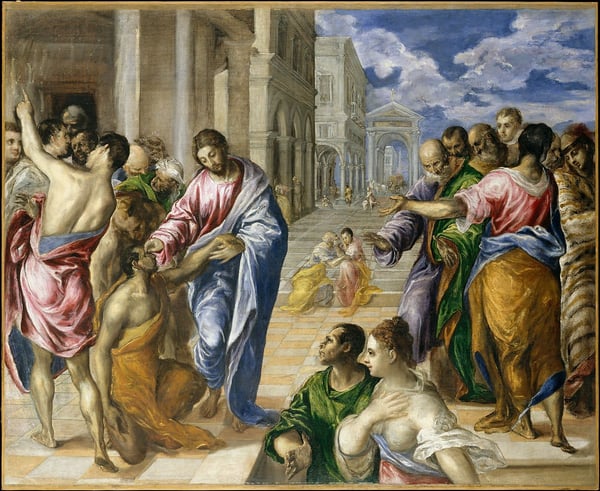
This early work by El Greco—produced during his Cretan period (before his move to Italy and Spain)—holds a pivotal place in the artist’s development and in the broader transition from Byzantine tradition to Western Mannerism. Painted while he was still a master of the Cretan School, the work fuses the hieratic, gold-ground iconography of Eastern Orthodox art with the spatial and emotional innovations of the Late Renaissance.
What makes it significant:
-
A Hybrid of Two Worlds – The composition retains the iconic frontality and flattened space of Byzantine icons (figures face the viewer, gestures are symbolic), yet it introduces Mannerist elements: the unnaturally twisted pose of the blind man, the stark chiaroscuro, and the compression of deep space into a crowded foreground. This marriage of Eastern and Western conventions marks El Greco’s earliest departure from pure icon painting.
-
Mannerist Distortion as Expression – The elongated, almost boneless limbs of Christ and the supplicant, the cramped spatial arrangement, and the lack of atmospheric depth are hallmarks of Mannerism’s “anti-classical” style. But here these distortions serve a devotional purpose: the spiritual urgency of the miracle is conveyed through physical tension and exaggerated gesture, prefiguring the ecstatic, elongated figures of El Greco’s later Toledan masterpieces.
-
Emotional Intimacy in a Religious Narrative – Unlike many earlier Renaissance healing scenes (often crowded or didactic), El Greco isolates the central encounter. Christ’s hand hovers over the blind man’s eyes with a gentle authority, while the dark, neutral background eliminates distraction. This focuses attention on the moment of divine touch—a psychological intensity that would become El Greco’s signature.
-
Color as Spiritual Light – The palette is already proto-Mannerist: cold, silvery blues and acidic greens against warm ochres and crimson, with sharp highlights that seem to emanate from within the figures rather than from an external source. This prefigures the unearthly, flickering light of his later works (e.g., The Burial of the Count of Orgaz) and ties the miracle to a supernatural, transcendent realm.
-
Forecast of a Revolutionary Style – Though still tethered to Cretan conventions (the gold ground is absent, but the framing and halos suggest icon conventions), this painting anticipates the dissolution of naturalistic space and the elongation of form that define El Greco’s mature Mannerism. It is a crucial link between the Byzantine icon tradition and the radical, almost modern spirituality of his Spanish period.
In essence, “Christ Healing the Blind Man” is not merely a derivative late-Renaissance work, but a document of artistic transformation—a Cretan icon painter reaching toward the emotional and formal freedom of Western Mannerism, and in doing so, beginning to forge a style entirely his own.
Visivamente simili
20 opere con composizione e palette affini
Christ healing the blind
El Greco
Christ driving the traders from the temple
El Greco
Joseph Reconnu Par Ses Frères
Giovanni Battista Gaulli
The Death of Sapphira
Nicolas Poussin
The Incredulity of St. Thomas
Giorgio Vasari
Christ driving the Traders from the Temple
El Greco
The Death of Saphire
Nicolas Poussin
Christ driving the traders from the temple
El Greco
The Purification of the Temple
El Greco
The Pool
Palma il Giovane
Saints Peter and John Healing the Lame Man
Nicolas Poussin
The Preaching of St. Paul at Ephesus
Eustache Le Sueur
The Tribute Money
Joachim Wtewael
Washing of the Feet
Palma il Giovane
The Marriage of the Virgin
Jacques Stella
Christ at the Pool of Bethesda
Bartolome Esteban Murillo
Conversion of Mary Magdalene
Paolo Veronese
Psyche Honoured by the People
Luca Giordano
The death of Virginia
Vincenzo Camuccini
La Justification De Suzanne
Jacques Réattu