Analisi esperta di The Incredulity of St. Thomas di Giorgio Vasari
Stile: Mannerism (Late Renaissance) · Genere: religious painting
As an expert art historian, here is an analysis of "The Incredulity of St. Thomas" by Giorgio Vasari, focusing on its significance within the Mannerist (Late Renaissance) style and the religious painting genre.
Significance within Mannerism
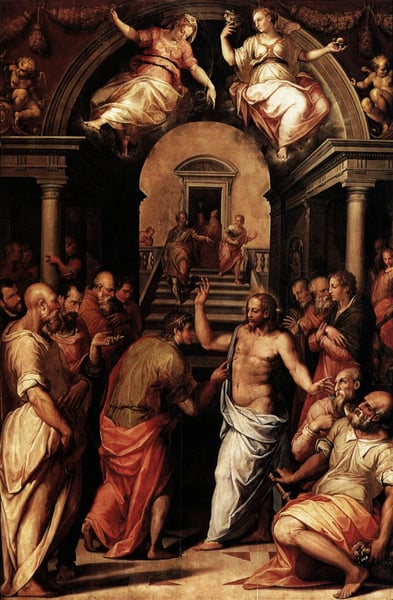
This painting is a quintessential example of Mannerist's deliberate departure from the balanced harmony of the High Renaissance. Vasari, a key theorist and practitioner of Mannerism, uses the biblical subject of Doubting Thomas to showcase the movement's core values:
-
Complex Composition and Unnatural Poses: True to Mannerist artifice, Vasari arranges the figures in a crowded, serpentine configuration. The bodies twist and turn—especially St. Thomas as he reaches toward Christ’s wound—creating a sense of instability and tension. This figura serpentinata (twisted figure) is a hallmark of Mannerist virtuosity, prioritizing aesthetic complexity over naturalistic repose.
-
Emotional and Psychological Intensity: The work emphasizes the dramatic moment of doubt and proof. Rather than a calm revelation, Vasari heightens the emotional charge. The gestures are theatrical: Thomas’s probing hand and Christ’s exposed side are brought into stark, almost uncomfortable focus. This psychological tension—doubt before faith—is rendered with a Mannerist flair for exaggerated expression.
-
Stylized Color and Light: The palette is deliberately artificial and cool, with acidic greens, sharp pinks, and metallic highlights. The lighting is uneven and theatrical, casting stark shadows that accentuate the muscular forms and the central wound. This unnaturalism separates the scene from everyday reality, elevating it into a realm of refined, spiritual artifice—a key Mannerist goal.
-
Vasari’s Dual Role: As the author of Lives of the Most Excellent Painters…, Vasari codified Mannerist theory. This painting is significant because it demonstrates his ideals in practice: the artist’s learned skill (disegno) triumphs over mere imitation of nature. The work is a manifesto of Mannerist style, showing how a traditional religious story could be reimagined through intellectual complexity and elegant, unnatural form.
In summary, Vasari’s The Incredulity of St. Thomas is significant not as a devotional image, but as a sophisticated demonstration of Mannerist principles—artful complexity, emotional agitation, and a self-conscious display of the artist’s technique—that defined the Late Renaissance.
Museum / Gallery
Visivamente simili
20 opere con composizione e palette affini
The Incredulity of Thomas
Maarten de Vos
The Incredulity of St Thomas
Francesco de' Rossi (Francesco Salviati), "Cecchino"
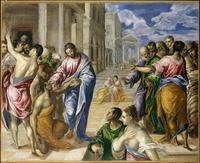
Christ healing the blind man
El Greco
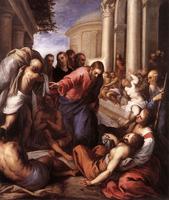
The Pool
Palma il Giovane
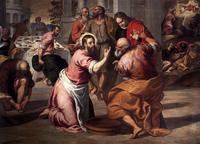
Washing of the Feet
Palma il Giovane
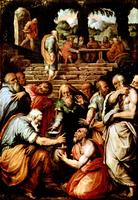
The Prophet Elisha cleansing Naaman
Giorgio Vasari
The Judgement of Solomon
Luca Giordano
The Purification of the Temple
El Greco
Christ driving the Traders from the Temple
El Greco
Christ healing the blind
El Greco
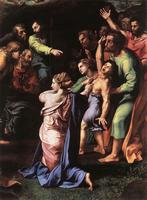
The Transfiguration (detail)
Raphael
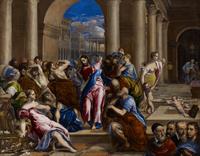
Christ driving the traders from the temple
El Greco
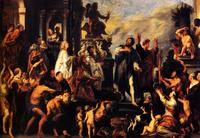
The Apostles, St. Paul and St. Barnabas at Lystra
Jacob Jordaens
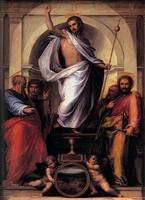
Christ with the Four Evangelists
Fra Bartolomeo
DIE RÜCKKEHR DES VERLORENEN SOHNES
Ludovico Carracci
Madonna Enthroned and Ten Saints
Rosso Fiorentino
Esther before Ahasuerus
Nicolas Poussin
La Résurrection De Lazare
Thomas Blanchet
The raising of Lazarus
Hendrik Heerschop
Joseph Reconnu Par Ses Frères
Giovanni Battista Gaulli