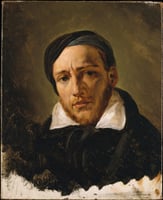
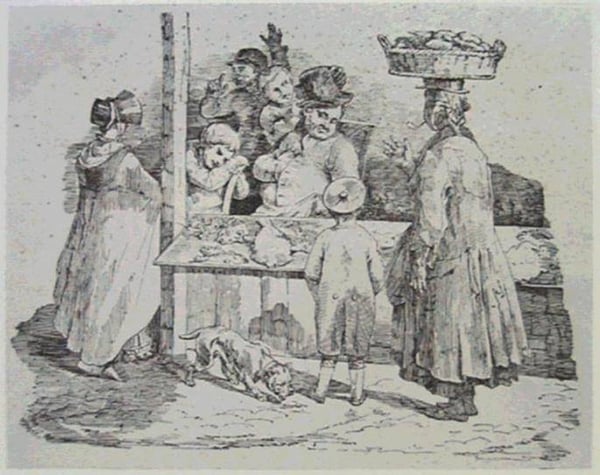
Théodore Géricault sanatçısının The asleep fishmonger eseri hakkında uzman analizi
Tarz: Romanticism · Tür: genre painting
Expert Analysis of “The Asleep Fishmonger” by Théodore Géricault
Within the canon of Romanticism, Théodore Géricault is celebrated for his monumental, emotionally charged works such as The Raft of the Medusa. Yet “The Asleep Fishmonger”—a genre painting—reveals a quieter, equally significant facet of his genius. Here, Romanticism’s preoccupation with the raw, untamed aspects of human experience is distilled into the everyday: a humble laborer, exhausted mid-task, slumbers beside his stall.
Significance within Romanticism and Genre Painting
-
Democratization of the Sublime: Romantic artists often sought the sublime in nature or heroic struggle. Géricault instead locates it in the mundane. The fishmonger’s slumped form, the relaxed grip on a fish, the shadowed face—these details elevate a transient moment of fatigue into a meditation on human endurance. The viewer is invited to empathize with the worker’s vulnerability, a hallmark of Romantic sensitivity to individual experience.
-
Chiaroscuro and Emotional Depth: Though we cannot see the painting’s palette, Géricault’s characteristic use of strong contrasts between light and dark would likely dramatize the scene. The sleeping figure, partially obscured in shadow, becomes a study in chiaroscuro symbolic of the Romantic tension between consciousness and oblivion, labor and rest. The fish—icons of both livelihood and mortality—echo the period’s fascination with life’s fragility.
-
Defying Neoclassical Hierarchy: Genre painting was historically considered lower in the academic hierarchy. By choosing a sleeping fishmonger as his subject, Géricault aligns with the Romantic rebellion against Neoclassical idealism. He asserts that the dignity of a common figure—a fishmonger, not a hero—merits the same rigorous observation and emotional weight as a historical or mythological scene.
-
Bridge to Realism: This work anticipates the later Realist movement. Géricault’s unflinching, unsentimental portrayal of a worker’s exhaustion—without allegory or moralizing—prefigures Courbet and Millet. It grounds Romanticism’s emotional intensity in tangible, everyday reality, making “The Asleep Fishmonger” a pivotal piece that demonstrates how Romanticism could honor the quotidian without sacrificing its core fervor.
In summary, “The Asleep Fishmonger” is significant for its quiet revolution: it proves that Romanticism’s power lies not only in shipwrecks and nightmares, but in the profound stillness of a laborer asleep at his post.
Görsel olarak benzer
İlişkili kompozisyon ve renk paletine sahip 20 eser

Delpech Lithographic Print Shop
Carle Vernet
TOUT VIENT À QUI SAIT ATTENDRE
John Leech

ZOOLOGY
John Leech

The Neapolitan nougat seller
Saverio della Gatta
La Rue & Alsace
Julien Le Blant

BEHIND THE SCENES
John Leech
Le Marchand de Gaufres
Theophile Steinlen
THE UNDERGROUND RAILWAYS
John Leech

A CAUTION
John Leech
The strolling musicians
Rembrandt
La Chanson De Nature
Theophile Steinlen
It is better to be idle
Francisco Goya
The arrival of a governess in a merchant's house
Vasily Perov
Bout de Rue Le Soir
Theophile Steinlen
Beggar man and woman
Rembrandt

Rue de Strasbourg
Julien Le Blant
The fruit women (after a drawing by Josef Lanzedelly)
Heinrich Papin
Russian proverbs and sayings
Viktor Vasnetsov
Times of the Day: Evening
William Hogarth

La Petite Marchande du f.g. J.t. Martir
Julien Le Blant