Théodore Géricault の The three skulls の専門的な分析
スタイル:Realism · ジャンル:still life
Artwork Analysis: The Three Skulls by Théodore Géricault
Style: Realism
Genre: Still Life
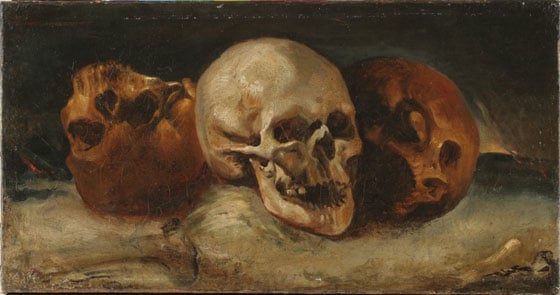
While Théodore Géricault is best known as a leading figure of Romanticism, The Three Skulls exemplifies a raw, unflinching commitment to Realist principles—specifically, the objective observation of the physical world. Painted as a preparatory study for his monumental Raft of the Medusa, this still life transcends its genre through its stark anatomical precision and psychological weight.
Significance within Realism and Still Life Tradition:
-
Memento Mori with Scientific Detachment: Géricault approaches the skulls not as symbolic props but as tangible, volumetric forms. The careful modeling of bone structure, the play of light across cranium and jaw, and the subtle tonal gradations reflect a dissection‑room clarity. This aligns with Realism’s insistence on direct, empirical observation—here applied to human remains.
-
From Romanticism to Realist Rigor: Although Géricault’s larger works pulse with dramatic emotion, this still life suppresses narrative excess. The three skulls are arranged in a simple triangular composition, each turned at a slightly different angle to emphasize their individuality. The result is a quiet, almost clinical meditation on mortality, prefiguring the unadorned truth‑telling of later Realists like Courbet.
-
Technical Mastery: The brushwork is both precise and expressive—tight enough to render sutures and cracked bone, yet loose enough in the shadowed areas to suggest the soft decay of flesh that once covered them. This balance of control and spontaneity distills Géricault’s skill as a draftsman and his deep study of anatomy, gained from dissecting cadavers in preparation for The Raft of the Medusa.
-
Context of the Medusa: The three skulls likely served as studies for the corpses and severed heads in the shipwreck scene. In isolation, they become a concentrated emblem of the painting’s theme: human suffering, the fragility of life, and the impartial gaze of death. The work thus occupies a unique position—part scientific study, part existential still life—that bridges Romantic fervor and the emerging Realist ethos.
In The Three Skulls, Géricault demonstrates that a still life can be as intellectually charged as a history painting. Its significance lies in its refusal to sentimentalize death, offering instead a blunt, empirical beauty that honors the Realist creed: truth before allegory.
視覚的に類似
構図やパレットが近い作品 20 件
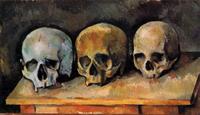
The Three Skulls
Paul Cezanne
Vanitas
Alejandro Cabeza
Pyramid of skulls
Paul Cezanne
Study of skull
Nicholas Roerich
Triptych
Mariotto Albertinelli
Vanitas (Three skulls)
Georg Scholz
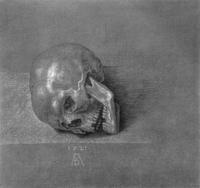
Skull
Albrecht Durer
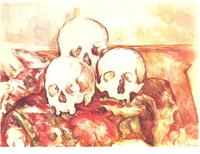
Still life with three skulls
Paul Cezanne
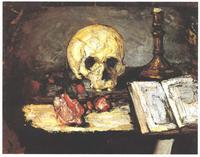
Still life with skull, candle and book
Paul Cezanne
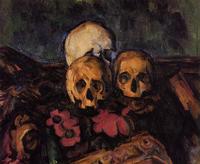
Three Skulls on a Patterned Carpet
Paul Cezanne
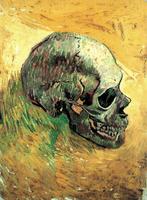
Skull
Vincent van Gogh
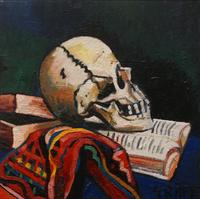
Vanitas
Matthias Laurenz Gräff
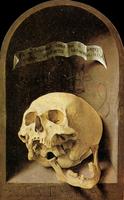
Skull
Mabuse
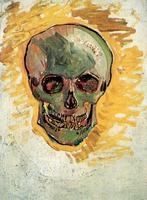
Skull
Vincent van Gogh
Skulls
Nicholas Roerich
Still Life Skull and Waterjug
Paul Cezanne
Skull
Gregoire Boonzaier
Vanitas. Still Life
Pieter Claesz
Still Life. Skull and Writing Quill
Pieter Claesz
Skull
Hans Wechtlin