Expert analysis of Paul Cezanne’s Three Skulls on a Patterned Carpet
Style: Post-Impressionism · Genre: vanitas
Expert Analysis: "Three Skulls on a Patterned Carpet" by Paul Cézanne
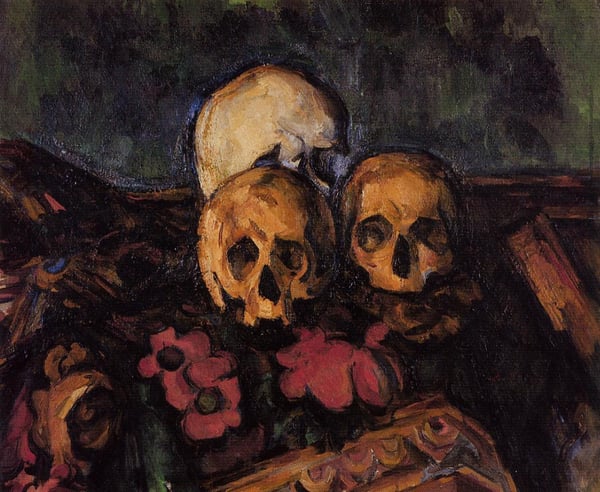
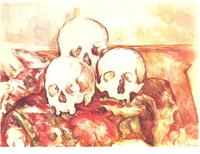
Paul Cézanne’s Three Skulls on a Patterned Carpet (c. 1900–1904) stands as a profound culmination of his late period, merging the traditional vanitas genre with the formal innovations of Post-Impressionism. This work is significant for several reasons:
1. A Modern Vanitas in Cézanne’s Final Period
While vanitas paintings—still lifes that remind viewers of mortality through symbols like skulls—were common in the 17th century, Cézanne’s approach is distinctly modern. Here, the three skulls are stripped of Baroque drama or moralizing allegory; instead, they become formal objects of intense sculptural study. Painted in his final period (the early 1900s), this work reflects Cézanne’s obsessive focus on capturing the underlying structure of nature through color and geometry. The skulls are not merely morbid symbols but vehicles for exploring volume, light, and the relationship between objects in space.
2. Formal Innovation: Carpet as Spatial Weave
The patterned carpet is no mere background—it is a radical formal device. Cézanne flattens the picture plane by weaving the carpet’s geometric motifs into the same chromatic fabric as the skulls. The skulls themselves are built from patches of blue, ochre, and white, their contours dissolving into adjacent color areas. This “constructive stroke” technique—where brushstrokes model form through varied hues—anticipates Cubism. The carpet’s repeated patterns create a rhythmic tension that pulls the eye across the canvas, while the skulls anchor the composition, their solidity emerging from the interplay of warm and cool tones.
3. The Skulls as “Monumental” Still LIfe Objects
Cézanne often painted skulls in his late still lifes (alongside apples, pitchers, and drapery) to test his theory that “all forms in nature are based on the sphere, the cone, and the cylinder.” Here, the three skulls—arranged in a deliberate, asymmetrical cluster—are rendered as heavy, volumetric spheres. The leftmost skull tilts downward, the central one faces forward, and the right skull cants sideways, inviting the viewer to move around them mentally. This play of axes and planes exemplifies Cézanne’s desire to capture multiple perspectives simultaneously, a key step toward Cubism.
4. Significance Within Post-Impressionism and Beyond
At a time when Symbolists and the Nabis used skulls to evoke mysticism or fin-de-siècle decay, Cézanne remained rigorously empirical. His vanitas is not a meditation on death’s inevitability but on the artist’s power to transform the transient into the eternal. The painting’s compressed space, fractured planes, and muted, earthy palette (with sudden accents of crimson and green) demonstrate Cézanne’s move toward abstraction. Later, both Picasso and Braque would cite works like this as inspiration for their fragmented still lifes of the 1910s.
In summary, Three Skulls on a Patterned Carpet is significant because it reimagines a centuries-old vanitas theme through the lens of Cézanne’s late formal language, bridging traditional memento mori and the dawn of modernism. It is a testament to his belief that a paintbrush could build form as solidly as a mason builds a wall—even from the humble substance of bone and cloth.
Museum / Gallery
Visually similar
20 works with related composition and palette
Still life with skull, candle and book
Paul Cezanne
Still Life Skull and Waterjug
Paul Cezanne
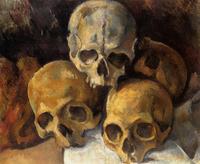
Pyramid of skulls
Paul Cezanne
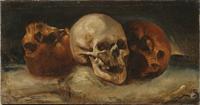
The three skulls
Théodore Géricault
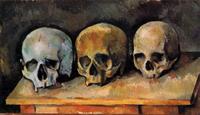
The Three Skulls
Paul Cezanne
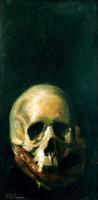
Vanitas
Alejandro Cabeza
Still life with three skulls
Paul Cezanne
Cranes Fleuris
James Ensor
Study of skull
Nicholas Roerich
Still Life with Skull
Arshile Gorky
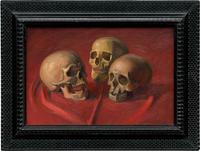
Vanitas (Three skulls)
Georg Scholz
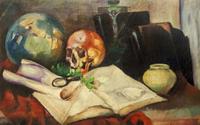
Still life with a skull
Nikola Martinoski
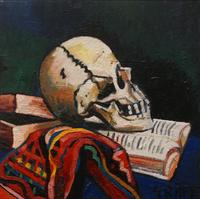
Vanitas
Matthias Laurenz Gräff
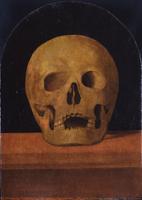
Triptych
Mariotto Albertinelli
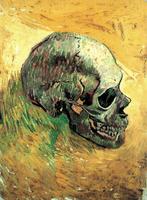
Skull
Vincent van Gogh
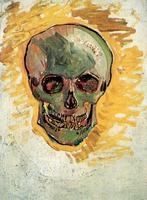
Skull
Vincent van Gogh
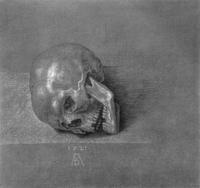
Skull
Albrecht Durer
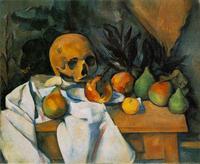
Still Life with Skull
Paul Cezanne
Vanitasstillleben mit Totenschädel, Seifenblasen und verlöschender Kerze
Edward Collier
VANITAS STILL LIFE
Edward Collier