Expertenanalyse zu Paul Cezannes The Three Skulls
Stil: Post-Impressionism · Genre: vanitas
Expert Analysis of "The Three Skulls" by Paul Cézanne
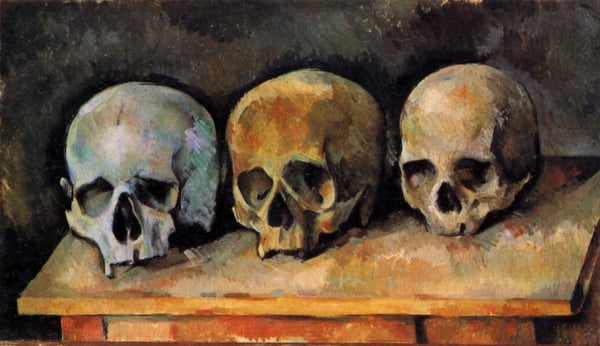
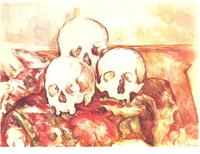
Paul Cézanne’s The Three Skulls (ca. 1902–1906) stands as a masterwork of his final period, a time when the artist’s quest for structure and monumentality reached its most distilled expression. Executed in the Post-Impressionist style, the painting belongs to the vanitas genre—a traditional meditation on the transience of life and the inevitability of death. Yet Cézanne transforms this age-old motif into a radical formal investigation that would profoundly influence the development of modern art.
Significance within Post-Impressionism and Cézanne’s Final Period
Cézanne’s late works are characterized by a rigorous simplification of form, a muted yet tactile color palette, and a deliberate flattening of pictorial space. In The Three Skulls, these elements converge with extraordinary economy. The three craniums are not rendered as macabre symbols but as sculptural volumes—almost architectural in their solidity. Cézanne builds each skull through careful modulations of ocher, umber, and creamy white, with touches of blue-gray to define shadow. The brushstrokes are parallel and hatched, a hallmark of his late technique, creating a fabric of color that holds the surface together while still suggesting depth.
Unlike earlier vanitas paintings that rely on dramatic chiaroscuro or allegorical props, Cézanne eliminates all narrative clutter. There is no candle, no hourglass, no wilted flower—only the skulls, set on a simple table or cloth. This starkness pushes the viewer to focus purely on the painterly relationships: the subtle tilt of each skull, the gaps between them, the way light fractures across curved bone. The composition eschews traditional symmetry; the skulls are grouped in a dense, slightly off-kilter cluster, forcing the eye to move dynamically across the canvas. This reflects Cézanne’s central concern: capturing not a fixed perspective but a sensation of multiple viewpoints simultaneously.
What Makes This Work Significant
-
Formal Innovation as Existential Statement: By stripping the vanitas to its essential motif and treating it with extreme formal discipline, Cézanne fuses theme and technique. The mortality of the subject is mirrored in the work’s own fragile, constructed surface—a paradoxical tension between decay and permanence. The skulls become vehicles for exploring how shape, color, and space can hold meaning without literary crutches.
-
Bridge to Cubism and Modernism: This painting epitomizes Cézanne’s late style, which Georges Braque and Pablo Picasso studied intently. The simplified, faceted handling of the skulls directly anticipates Cubist fragmentation. The emphatic brushwork and flattened picture plane also look forward to Expressionist and even Abstract paths. The Three Skulls is thus a pivotal link between Impressionist opticality and the conceptual geometry of 20th-century art.
-
Personal and Period Culmination: Created during Cézanne’s final years (he died in 1906), the painting carries an unmistakable air of self-reflection. Yet it avoids sentimentality. Instead, Cézanne treats the ultimate human end as a problem of painting—one to be solved through color relations and structural balance. This intellectualized approach to a deeply emotive subject marks the full maturity of Post-Impressionism’s ambition to see beyond mere appearance.
In The Three Skulls, Cézanne achieves what few artists have: he makes a vanitas that is less about fear of death than about the enduring life of form. The painting remains a touchstone for how the material of paint and the discipline of composition can elevate a conventional motif into a timeless meditation—on art, on perception, and on the quiet truth of our shared mortality.
Museum / Gallery
Visuell ähnlich
20 Werke mit ähnlicher Komposition und Farbpalette
Pyramid of skulls
Paul Cezanne
Vanitas (Three skulls)
Georg Scholz
Still life with three skulls
Paul Cezanne
The three skulls
Théodore Géricault
Study of skull
Nicholas Roerich
Triptych
Mariotto Albertinelli
Vanitas
Alejandro Cabeza
Skull
Albrecht Durer
Still life with skull, candle and book
Paul Cezanne
Skull
Vincent van Gogh
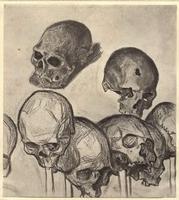
Skulls
Nicholas Roerich
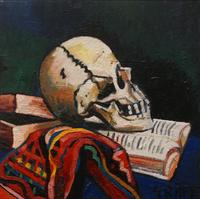
Vanitas
Matthias Laurenz Gräff
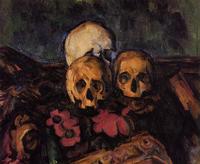
Three Skulls on a Patterned Carpet
Paul Cezanne
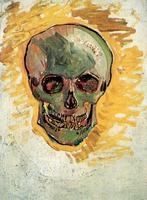
Skull
Vincent van Gogh
Still Life Skull and Waterjug
Paul Cezanne
Skull
Mabuse
Skull
Hans Wechtlin
Skull
Gregoire Boonzaier
Skull
Andy Warhol
St. John and Veronica Diptych (reverse of the left wing)
Hans Memling