Expert analysis of Michelangelo’s Study of nude man
Style: High Renaissance · Genre: sketch and study
Expert Analysis: Study of Nude Man by Michelangelo
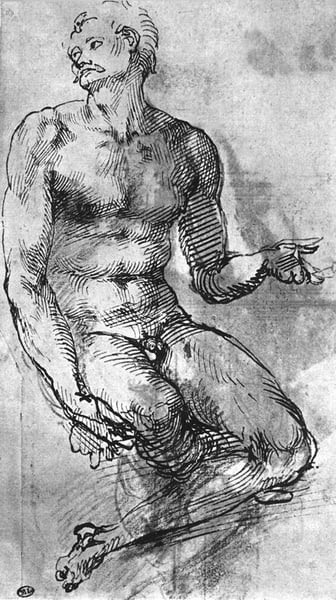
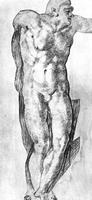
Michelangelo’s Study of Nude Man is a quintessential example of the High Renaissance approach to draftsmanship—a period in which drawing was elevated from a mere preparatory step to an art form in its own right. Executed in red chalk or pen and ink (typical of his surviving studies), this sketch reveals the artist’s obsessive, almost scientific investigation of the human body.
Anatomical Precision and Idealization
Michelangelo’s studies were not lifeless anatomical diagrams; rather, they combined rigorous observation of live models with a neo-Platonic ideal of human perfection. In this sketch, the nude figure is rendered with exaggerated musculature—the terribilità (awesome power) that defines his figures. The torsion of the torso, the precise mapping of shoulder blades, and the flexion of the legs show a deep understanding of human kinetics. The study likely served as a reference for a larger composition, such as a figure in the Sistine Chapel ceiling or a tomb sculpture, where the body’s physicality conveys spiritual struggle.
The High Renaissance Sketch as a Window into Process
Significantly, this work exemplifies the vital role of the disegno (drawing) in High Renaissance practice. Michelangelo saw drawing not as a preliminary notation but as a means of capturing the essence of form through line alone. The unfinished quality—with parallel hatching that models volume and visible pentimenti (reworked lines)—allows us to witness his creative decision-making. The contrast between the bold contour lines and the softer internal shading demonstrates his ability to suggest both structure and flesh.
Influence and Legacy
Such studies were closely guarded models for Michelangelo’s workshop and later became foundational for Mannerist artists, who exaggerated his muscular figures. Moreover, they represent a turning point in art history: the artist’s hand—with its vitality, expressiveness, and intellectual rigor—was prized as much as the finished commission. This sketch, though modest in scale, encapsulates the Renaissance belief that the human figure is the ultimate vehicle for artistic expression, and that the process of learning its secrets is itself a masterpiece.
Museum / Gallery
Visually similar
20 works with related composition and palette
Study for Adam
Raphael
Male Nude
Jacopo Pontormo
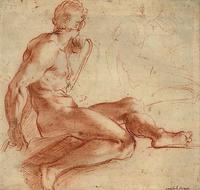
Nude Study
Annibale Carracci
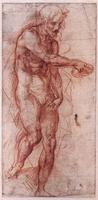
Study for the Baptism of the People
Andrea del Sarto
Study of nude man
Michelangelo
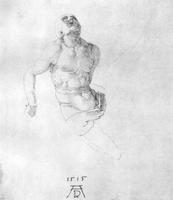
Study of a body of Christ
Albrecht Durer
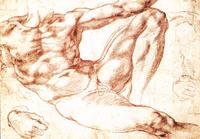
The Study of Adam
Michelangelo
Idol
Vincent van Gogh
Study of a nude youth
Georgios Jakobides
Study of a Nude Man
Michelangelo
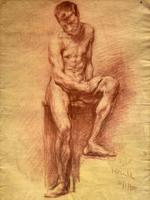
Study of a seated male nude
Umberto Veruda
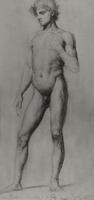
Male nude
Gustave Moreau
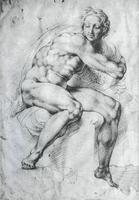
Naked Young Man
Peter Paul Rubens
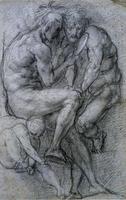
Two Male Figures Looking in a Mirror and a Putto.
Jacopo Pontormo
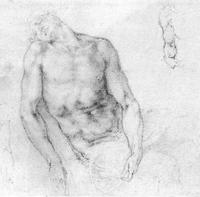
Study to "Pieta"
Michelangelo
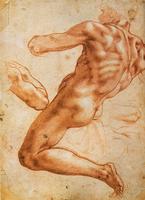
Study for an ignudo
Michelangelo
Atlante
Annibale Carracci
Nude Self-portrait
Albrecht Durer
Standing Male Nude Seen from the Front
Vincent van Gogh
Study to "Battle of Cascina"
Michelangelo