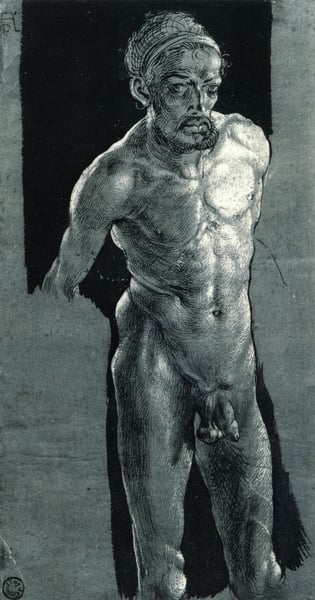
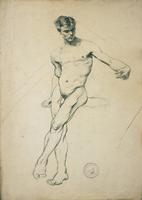
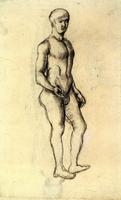
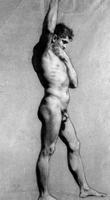
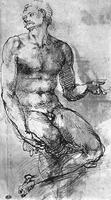
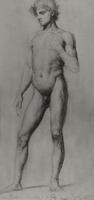
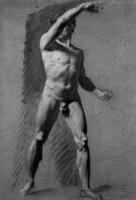
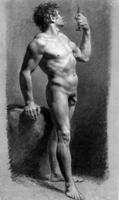
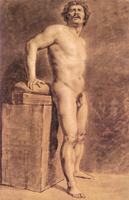
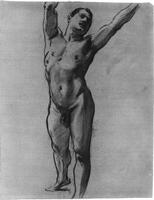
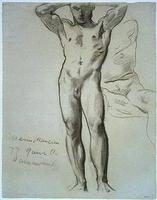
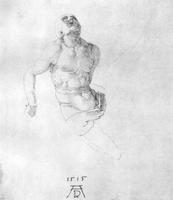
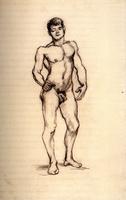
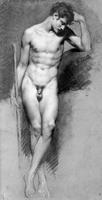
This artwork, Albrecht Dürer’s Nude Self-portrait, is a landmark of the Northern Renaissance. Executed as a self-portrait, it is one of the earliest known examples of a fully nude, frontal self-representation by a Western artist.
Its significance lies in Dürer’s radical merging of meticulous Northern naturalism with the humanist self-scrutiny emerging from the Italian Renaissance. Rather than idealizing his body, Dürer presents an unflinchingly honest, almost clinical study of his own form — complete with bony shoulders, soft belly, and a reserved yet direct gaze. This act of documenting his own physicality elevates the self-portrait from a mere likeness to a profound meditation on mortality, artistic identity, and the human condition.
In the context of the Northern Renaissance, where symbolic and spiritual concerns often dominated, Dürer’s decision to depict himself nude and alone — without mythological or religious pretext — is a bold assertion of the artist as an individual subject worthy of serious contemplation. The work thus anticipates the introspective self-examination that would become a hallmark of later Western art.