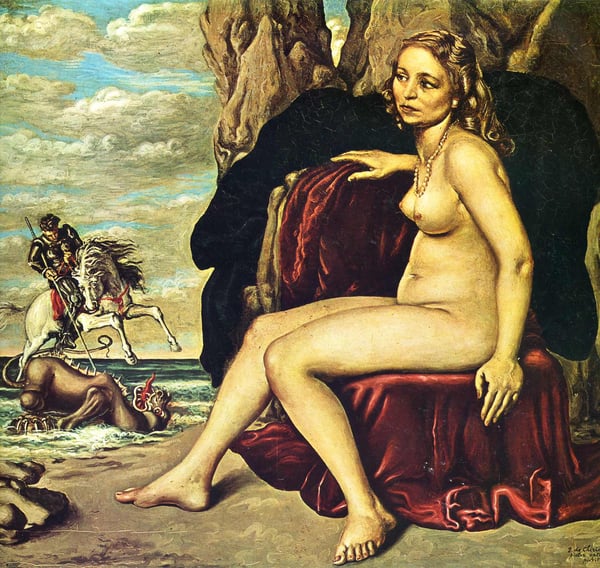
Based solely on the provided facts, "St. George Killing the Dragon" by Giorgio de Chirico is a Neo-baroque allegorical painting whose significance lies in its revival of Baroque dynamism and theatricality within a modern allegorical framework. As a Neo-baroque work, the painting likely amplifies the classic Baroque traits of dramatic tension, strong chiaroscuro, and sweeping movement—using these to heighten the moral struggle inherent in the allegory of good (St. George) triumphing over evil (the dragon). What makes it particularly significant is how de Chirico, known for his earlier Metaphysical style, here adapts the traditional religious and chivalric allegory to the Neo-baroque idiom. By doing so, he infuses a timeless narrative of virtue with the intense physicality and emotional grandeur characteristic of the Baroque period, while recontextualizing it for a modern audience. This fusion of a medieval allegorical subject with the vigorous, sculptural forms and dramatic lighting of Neo-baroque art underscores the work’s importance as a deliberate, historical-stylistic reinterpretation—a dialog between past grandeur and present allegorical concerns.