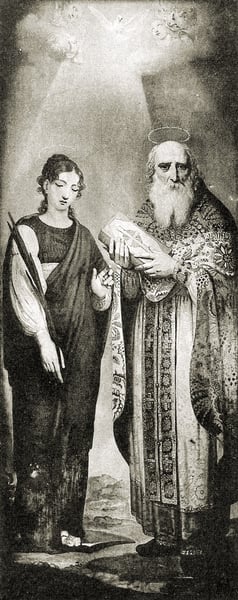
St. Juliana
Expertenanalyse zu Vladimir Borovikovskys St. Juliana
Stil: Rococo · Genre: religious painting
Expert Analysis of "St. Juliana" by Vladimir Borovikovsky
This work occupies a fascinating and rare intersection in art history: a Russian Orthodox religious subject rendered through the lens of Western European Rococo. While Borovikovsky is best known for his sensitive, sentimental portraits of Russian nobility, "St. Juliana" demonstrates his ability to infuse sacred imagery with the same graceful elegance that defines his secular masterpieces.
Significance within Style and Period:
-
Rococo’s Intimate Spirituality: Unlike the grand, dramatic religious altarpieces of the Baroque, Borovikovsky’s Rococo approach emphasizes delicacy, softness, and personal devotion. The saint would likely be depicted with a gentle, contemplative expression and a slender, almost ethereal figure, bathed in muted pastel tones typical of the style. The composition probably avoids overt drama, instead inviting quiet reverence.
-
Fusion of Russian and Western Traditions: Borovikovsky was a pivotal figure in bringing Rococo’s refined aesthetics to Russian art. In "St. Juliana," he likely blends traditional Orthodox iconographic elements (such as the saint’s attributes or a gold-halo-like glow) with the soft sfumato, playful drapery, and pastoral or interior setting characteristic of Western Rococo. This synthesis makes the painting significant as a cultural bridge, demonstrating how Russian artists adapted a predominantly secular European style for local devotional purposes.
-
Sentimentalism and Humanization: The artist’s portraits often capture a tender, melancholic warmth. Applying this to a saint, Borovikovsky humanizes the holy figure—not as a distant, rigid icon, but as a relatable, gentle soul. This aligns with Rococo’s broader shift toward private, emotional experience in art, making "St. Juliana" a key example of how the period reimagined sanctity as intimate and accessible.
Conclusion: While religious painting was less common in Borovikovsky’s Rococo oeuvre, "St. Juliana" stands out as a testament to the style’s adaptability. It merges the artist’s signature softness with sacred iconography, offering a uniquely Russian Rococo vision that remains significant for its cultural and stylistic hybridity.
Visuell ähnlich
20 Werke mit ähnlicher Komposition und Farbpalette

Saint Atilano
Vicente Juan Masip
St.Tsaritsa Alexandra
Vladimir Borovikovsky
San León Magno
Francisco de Herrera the Younger
San Agostino
Palma il Giovane
Kazimierz I Odnowiciel
Jan Matejko
Wenceslaus II
Jan Matejko
Images of the VC. Vasily Dmitrievich and VC. Sofia Vitovtovna
Fyodor Solntsev

Portrait of Pope Pius V
Palma il Giovane

St. Isidore of Seville
Bartolome Esteban Murillo
Wenzel III
Josef Kriehuber
Stephan II
Josef Kriehuber
St. Fridolin
Albrecht Durer
St Augustine
Maarten de Vos
St. Paul (First State)
Albrecht Durer
St. Romanus and St. Barulas of Antioch
Francisco de Zurbaran
St. Lawrence
Francisco de Zurbaran
Apparition of the Virgin and Child to Saint Ubald of Gubbio, Who Points to the City of Pesaro
Palma il Giovane
St. Augustine
Peter Paul Rubens
Cyril and Methodius
Jan Matejko
Saint Ambrose
Gaspar de Crayer