
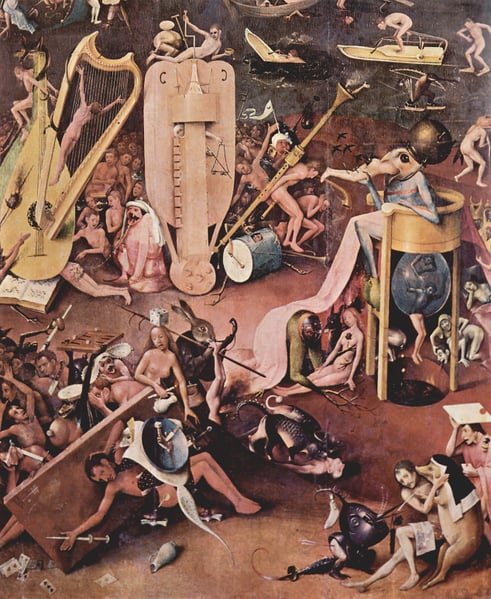
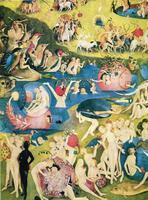
The Garden of Earthly Delights (detail)
Dettagli
Analisi esperta di The Garden of Earthly Delights (detail) di Hieronymus Bosch
Stile: Northern Renaissance · Genere: religious painting
Expert Analysis: The Garden of Earthly Delights (detail) by Hieronymus Bosch
Hieronymus Bosch’s The Garden of Earthly Pleasures (c. 1490–1510) is one of the most enigmatic and visionary works of the Northern Renaissance. While the overall altarpiece is a triptych that traces humanity’s fall from innocence into sin and eventual damnation, even a single detail encapsulates Bosch’s revolutionary approach to religious painting.
Significance within the Northern Renaissance
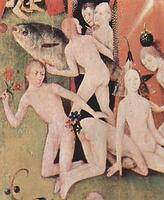
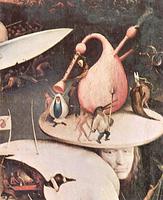
The Northern Renaissance was characterized by meticulous realism, symbolic detail, and a deep engagement with Christian morality. Bosch, however, pushed these conventions to their imaginative extremes. Unlike his Flemish contemporaries (e.g., Jan van Eyck or Rogier van der Weyden), who depicted sacred scenes with serene clarity, Bosch populated his paradise and hell with surreal, nightmarish creatures, hybrid forms, and grotesque moral allegories. The detail shown—typically from the central panel of the triptych—reveals a teeming, chaotic garden where nude figures cavort among giant fruit, strange structures, and fantastic animals. This is not a literal Eden but a moralized fantasy, warning against worldly pleasure through bizarre imagery that bypasses reason to confront the viewer’s subconscious.
Religious Painting Transformed
The work is a religious allegory rooted in the medieval tradition of memento mori and sin, yet it breaks from didactic clarity. Bosch employs a highly personal symbolic language: oversized strawberries suggest fleeting, carnal sweetness; glass orbs and aquatic motifs evoke fragility and the transience of life. The sinuous, almost hallucinatory composition forces the viewer to decipher each element, encouraging meditation on human folly. This complexity makes the piece a precursor to Surrealism and a landmark in the history of moralizing art, proving that religious painting could be both terrifyingly imaginative and profoundly instructive.
Why It Endures
The detail from The Garden of Earthly Delights exemplifies Bosch’s mastery of creating a self-contained universe where every object carries weight. The work’s significance lies in its radical departure from static religious iconography, offering instead a dynamic, unsettling vision that remains psychologically potent centuries later. It is a masterpiece of the Northern Renaissance precisely because it marries obsessive naturalistic detail (e.g., the rendering of flora and anatomy) with an almost modern psychological depth, making it a touchstone for the power of art to explore moral chaos through beauty.
Museum / Gallery
Visivamente simili
20 opere con composizione e palette affini

The Garden of Earthly Delights (detail)
Hieronymus Bosch
The Last Judgement (detail)
Hieronymus Bosch
The Garden of Earthly Delights (detail)
Hieronymus Bosch

The Haywain Triptych (detail)
Hieronymus Bosch
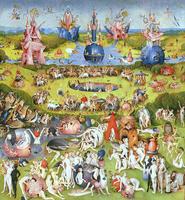
The Garden of Earthly Delights (detail)
Hieronymus Bosch

The Garden of Earthly Delights (detail)
Hieronymus Bosch
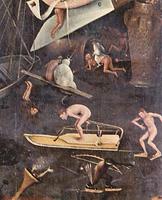
The Garden of Earthly Delights (detail)
Hieronymus Bosch
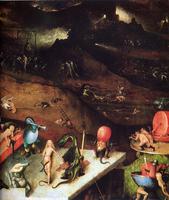
The Last Judgement (detail)
Hieronymus Bosch

The Garden of Earthly Delights (detail)
Hieronymus Bosch
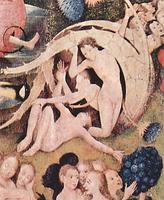
The Garden of Earthly Delights (detail)
Hieronymus Bosch
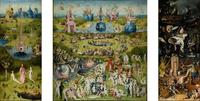
The Garden of Earthly Delights
Hieronymus Bosch

Temptation of St. Anthony (detail)
Hieronymus Bosch
The Temptation of St. Anthony (detail)
Hieronymus Bosch
Allegory of Gluttony and Lust
Hieronymus Bosch

The Last Judgement
Lucas Cranach the Elder
The Garden of Earthly Delights (detail)
Hieronymus Bosch
The Garden of Earthly Delights (detail)
Hieronymus Bosch
The Garden of Earthly Delights (detail)
Hieronymus Bosch

The Garden of Earthly Delights (detail)
Hieronymus Bosch
The Last Judgement (detail)
Hieronymus Bosch