Analisi esperta di The Camper di Fernand Leger
Stile: Naïve Art (Primitivism) · Genere: genre painting
Expert Analysis of "The Camper" by Fernand Léger
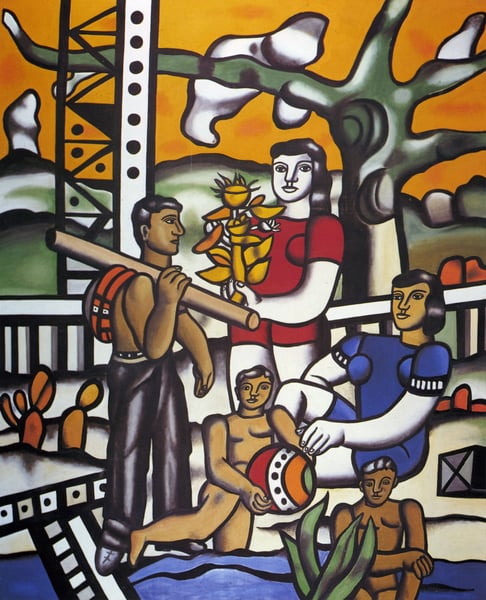
Despite Fernand Léger’s better-known associations with Cubism and the machine aesthetic, The Camper stands as a compelling example of his engagement with Naïve Art (Primitivism) —a style defined by its deliberate rejection of academic refinement in favor of bold, simplified forms, flat planes of color, and a childlike directness. As a genre painting, it captures a moment of everyday leisure, yet Léger transforms the ordinary scene into a monumental, almost iconic composition.
Significance within Naïve Art & Primitivism:
- Radical simplification: Léger reduces the camper—likely a figure or a camping scene—to essential geometric shapes and unmodulated color patches. This echoes the Primitivist impulse to strip away illusionistic depth and detail, evoking the raw energy of folk art or non-Western visual traditions.
- Vibrant, non-naturalistic palette: The use of primary colors and stark contrasts (e.g., red, blue, yellow, black) creates a rhythmic, decorative surface. This reflects Primitivism’s preference for emotional immediacy over realistic representation.
- Flatness and frontal composition: The figures and objects are pushed to the picture plane, denying perspective. This “naïve” approach aligns with Léger’s broader interest in making art accessible and direct, and it foreshadows Pop Art’s later embrace of graphic clarity.
Interpretive Focus:
- The title “The Camper” suggests a modern subject (tourism, outdoor recreation), yet Léger treats it with the same gravity as a ritual scene. The stylized, almost totemic rendering of the camper or camping equipment metaphorically bridges the urban-industrial world with a primal, pre-industrial visual language.
- The work challenges the boundary between “high” and “low” art. By applying a Primitivist lens to a banal modern activity, Léger elevates the mundane into a timeless, archetypal image—a hallmark of Naïve Art’s capacity to defamiliarize the familiar.
Conclusion:
The Camper is significant because it demonstrates how a leading modernist like Léger temporarily adopted Naïve Art’s conventions to critique sophistication and reconnect with a more instinctual mode of seeing. It stands as a rare but powerful example of Primitivism infiltrating the avant-garde, reminding us that the “naïve” eye can lend profound dignity to the simplest human act.
Museum / Gallery
Visivamente simili
20 opere con composizione e palette affini
The camper
Fernand Leger
The outing in the country
Fernand Leger
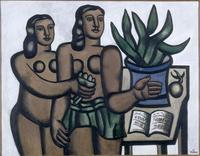
The two women in blue vase
Fernand Leger
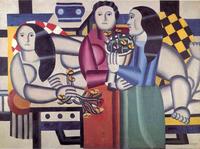
Three women with flowers
Fernand Leger
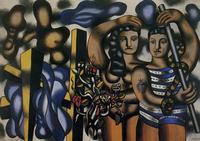
Adam and Eve
Fernand Leger
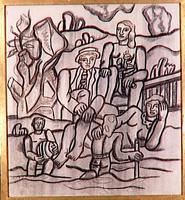
Study for the Party Campaign
Fernand Leger
The Fair
Maruja Mallo
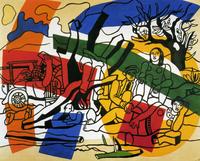
The Outing in the country
Fernand Leger
Female Cooks in the Forest
William Balthazar Rose
Three Characters
Fernand Leger
Figures in a Landscape at Ampurdan
Salvador Dali

Hawaiian Figure
Arman Manookian

Hawaiian Boy and Girl
Arman Manookian
Trouville
Fernand Leger
The Woman and the child
Fernand Leger
Untitled
Arman Manookian
Composition with the two parrots
Fernand Leger
The Art Movements
Mihnea Cernat
Fishermen
Fernand Leger

Mural
Arman Manookian