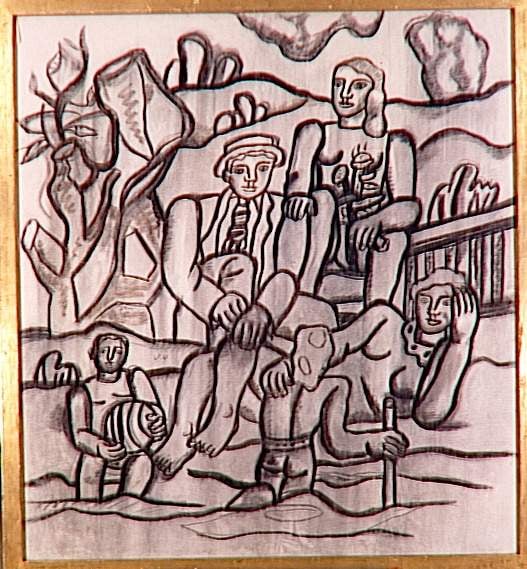
Study for the Party Campaign
Analisi esperta di Study for the Party Campaign di Fernand Leger
Stile: Naïve Art (Primitivism) · Genere: sketch and study
Expert Analysis of Fernand Léger’s Study for the Party Campaign
Style: Naïve Art (Primitivism) | Genre: Sketch and Study
Significance within Léger’s Oeuvre and the Naïve Art Period
Fernand Léger is celebrated for his mechanical, tubular forms and Cubist-futurist dynamism, yet Study for the Party Campaign reveals a striking departure into Naïve Art (Primitivism). This sketch is not a minor curiosity but a critical document of Léger’s post‑World War I search for direct, universal visual language—one that could speak to a broad, working-class audience.
1. Political Intent and Accessible Imagery
The title itself signals Léger’s engagement with socialist and communist ideas popular among avant‑garde artists in the 1920s–30s. By adopting a Naïve, flat, and simplified style (bold outlines, reduced detail, childlike proportions), Léger deliberately rejected the elitism of Cubist abstraction. This sketch distills complex political ideology into emblematic, easily “read” forms—a hallmark of Primitivism’s appeal to raw, unmediated expression.
2. Contrast with Léger’s Machine Aesthetic
Where Léger’s mature works feature metallic cylinders and rhythms of industry, this study strips away mechanical precision in favor of rounded, almost cartoonish figures and organic shapes. The Naïve approach here is not a regression but a strategic simplification—a way to convey the “party campaign” (likely a Communist election effort or propaganda drive) as an elemental, communal force. The sketch’s unfinished quality echoes Primitivism’s celebration of spontaneity over academic finish.
3. Place in Léger’s “Social Realist” Turn
Léger’s later murals and public commissions (e.g., The Builders, Leisure – Homage to Louis David) increasingly borrowed from folk art and children’s drawings. Study for the Party Campaign anticipates this shift: it proves that even a modernist master could temporarily shed sophistication to achieve direct emotional impact. The work stands as a bridge between high modernism and the populist pictorial language that Léger championed in his writings on “the new realism.”
4. Primitivism as Political Tool
Within the Naïve Art movement, this sketch is significant because it weaponizes primitivism for political mobilization. Unlike the self‑taught artists of the period (e.g., Henri Rousseau), Léger consciously mimics innocence to communicate revolutionary ideas. The result is a rare hybrid: a sophisticated artist’s study that retains the freshness of untutored expression while serving a calculated propaganda purpose.
Conclusion
Study for the Party Campaign is not merely a preparatory sketch but a manifesto in miniature. It demonstrates how a leading modernist subordinated his signature style to the demands of mass communication, using Naïve Art’s simplicity as a powerful political amplifier. For Léger, this work represents a pivotal moment when avant‑garde and proletarian art could briefly merge—a vision that would define his most engaged public projects.
Museum / Gallery
Visivamente simili
20 opere con composizione e palette affini
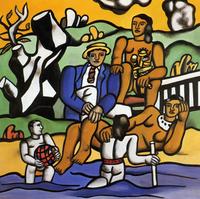
The outing in the country
Fernand Leger
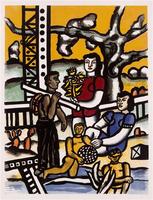
The camper
Fernand Leger
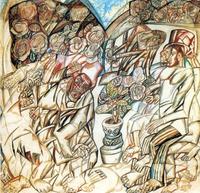
The Gardener
Pavel Filonov
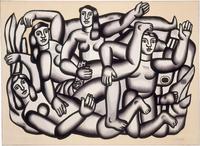
The Bathers
Fernand Leger
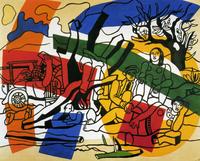
The Outing in the country
Fernand Leger
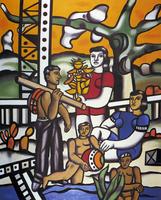
The Camper
Fernand Leger
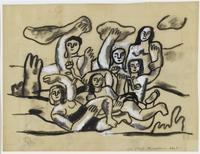
Study for The Bathers
Fernand Leger
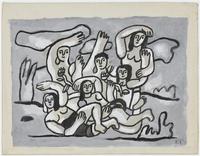
The Bathers
Fernand Leger
Fishermen
Fernand Leger
Hungarian gipsies
Endre Bartos
Figures in a Landscape at Ampurdan
Salvador Dali
The two women in blue vase
Fernand Leger
Bortnyik Sándor, Születés
Sandor Bortnyik
The Swimmers
Albert Gleizes
Acrobats in gray
Fernand Leger
Adam and Eve
Fernand Leger
Study for the Circus
Fernand Leger
After the Raid
Pavel Filonov
Three women with flowers
Fernand Leger
Bortnyik Sándor, Épitők
Sandor Bortnyik