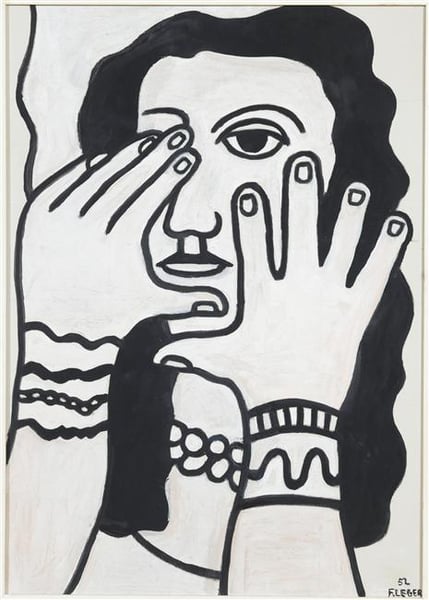
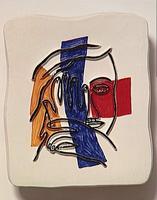
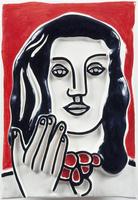
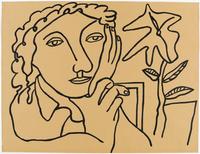
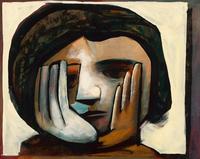
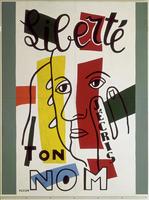
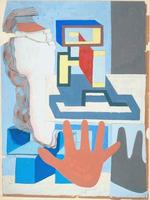
Fernand Léger’s The Woman with Black Hair stands as a striking example of his distinctive contribution to Cubism, particularly how he pushed the genre of portraiture beyond traditional representation. Unlike the more fragmented, muted palettes of Picasso and Braque’s Analytic Cubism, Léger embraced bold, machine-like forms and vivid color contrasts. Here, the woman’s black hair becomes a commanding geometric mass—often rendered as a smooth, tubular or disk-like shape—that anchors the composition. This reflects Léger’s fascination with the modern industrial world, where human figures are abstracted into clean, cylindrical volumes. The portrait’s significance lies in its fusion of Cubist structure with a dynamic, almost robotic vitality, anticipating his later shift toward Purism and monumental figuration. By simplifying the face into interlocking planes and emphasizing the stark opposition of black hair against bright primaries, Léger transforms a conventional portrait into a study of rhythm, order, and mechanized humanity—making it a key work in the development of Cubism’s more overtly modern, optimistic branch.