Analisi esperta di Moon Path di Ivan Aivazovsky
Stile: Romanticism · Genere: landscape
Expert Art Historical Analysis: Moon Path by Ivan Aivazovsky
Ivan Aivazovsky’s Moon Path (also known as Moonlit Seascape) is a quintessential example of Romantic landscape painting, specifically the sublime marine tradition that defined the artist’s career. Painted in the mid‑19th century, this work encapsulates Aivazovsky’s unparalleled ability to render the interplay of light, water, and atmosphere—a skill that elevated him from a mere chronicler of the sea to a poet of natural forces.
Significance within Romanticism
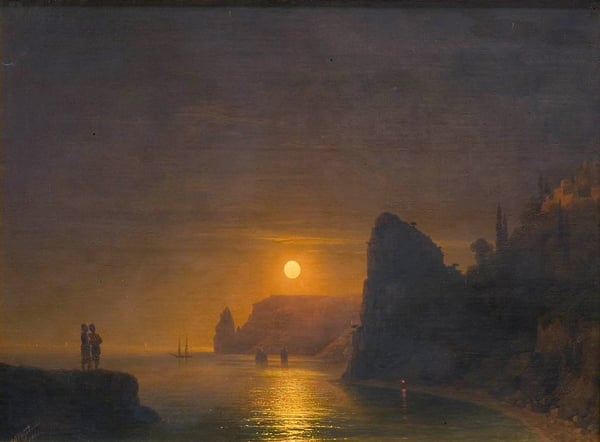
As a Romantic work, Moon Path transcends topographical accuracy to evoke emotion, solitude, and the overwhelming majesty of nature. The painting’s subject is not the specific coastline or vessel, but the ephemeral moment when moonlight fractures across a dark, gently undulating sea. Aivazovsky captures the Romantic fascination with the sublime—the simultaneous beauty and terror of the natural world. The vastness of the ocean, the infinite sky, and the small, anchored ship facing the moon all suggest humanity’s insignificance before nature’s grandeur, a core Romantic theme.
Mastery of Light and Atmosphere
Aivazovsky’s technical brilliance is on full display. The titular “moon path” is a shimmering, golden ribbon of reflected light that stretches from the horizon to the foreground, created through delicate, almost transparent layers of oil glaze. This luminous trajectory is contrasted with deep blues, greens, and blacks in the surrounding water and sky, producing a dramatic chiaroscuro that echoes the works of J.M.W. Turner and Caspar David Friedrich. The moon, partially veiled by wispy clouds, serves as the sole light source, casting a cool, silver‑gold glow that softens the edges of waves and the distant sail.
Composition and Emotional Impact
Aivazovsky employs a classical, balanced composition: the horizontal expanse of the sea dominates the lower two‑thirds, while the upper third is given to a wide, cloud‑streaked sky. A single ship, rendered in dark silhouette, sits near the center, its mast and rigging subtly catching the moonlight. This ship is not active—no dramatic storm, no crashing wave—yet its stillness conveys a profound sense of quiet loneliness and contemplation. The viewer is invited to stand on the shore or on the deck, gazing into the infinite, meditative void. This psychological depth—using a seemingly simple seascape to evoke introspection—marks Aivazovsky’s greatest contribution to landscape Romanticism.
Genre and Legacy
While Moon Path is firmly a landscape (specifically a marina), it redefines the genre by prioritizing mood over documentation. Aivazovsky produced over 6,000 paintings, many of moonlit seascapes, but this work is particularly exemplary for its restrained palette, subtle gradations of light, and the almost musical quality of its reflections. It stands as a testament to his belief that the sea was not merely a setting, but a living entity with an emotional and spiritual resonance. Moon Path remains significant as a defining icon of Romantic marine painting, influencing later Symbolist and even early Impressionist treatments of nocturnes and waterlight.
Visivamente simili
20 opere con composizione e palette affini
The monastery of George. Cape Fiolent
Ivan Aivazovsky
Sea at night
Ivan Aivazovsky
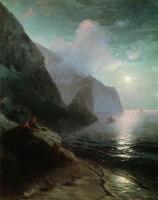
Pushkin in Gurzuf
Ivan Aivazovsky
Gurzuf night
Ivan Aivazovsky
Night in the Crimea. View of Ayu-Dag
Ivan Aivazovsky
Night at Crimea View on Ayu-Dag
Ivan Aivazovsky
Moonrise over Ayu Dag
Ivan Aivazovsky
Night in Amalfi
Ivan Aivazovsky
The sunset on sea
Ivan Aivazovsky
Chapel on the beach
Ivan Aivazovsky
Seascape. Cliffs at Sunset
William Bradford
Sunset on the Coast
Albert Bierstadt
Crimean Tartars on the Sea Shore
Ivan Aivazovsky
Full Moon in the Scottish Lowlands near Berwik-upon-Tweed
Carlo Bossoli
Fishing on the Black Sea
Arkhyp Kuindzhi
Coastal Landscape with crowds of Moonlight
Knud Baade
Rocky Coast at Sunset
William Hart
Sunset at Sea
Ivan Aivazovsky
Sea view
Ivan Aivazovsky
Sea
Ivan Aivazovsky