
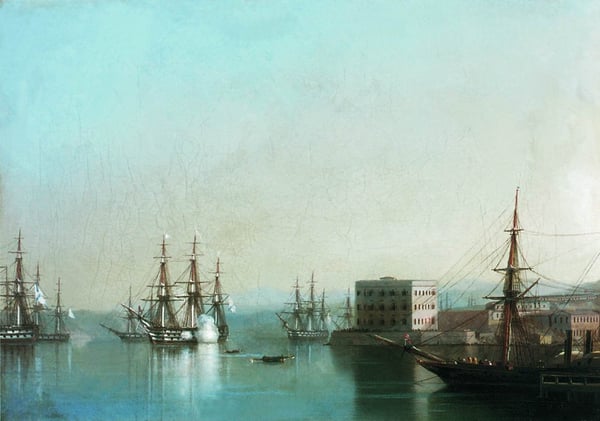
Ivan Aivazovsky sanatçısının Raid on Sevastopol eseri hakkında uzman analizi
Tarz: Romanticism · Tür: marina
Expert Analysis of Raid on Sevastopol by Ivan Aivazovsky
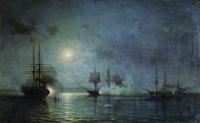
Ivan Aivazovsky’s Raid on Sevastopol stands as a quintessential example of Romanticism in the marine genre, capturing both the sublime power of nature and the heroism of human struggle. As a master of the seascape, Aivazovsky elevates this historical subject beyond mere documentation, infusing it with dramatic emotion and technical virtuosity.
Significance within Romanticism and the Marina Genre
-
Emotional Sublime: The painting embodies the Romantic fascination with the sublime—the overwhelming, awe-inspiring force of the sea. Aivazovsky’s trademark handling of light and atmosphere (often described as “liquid” or “translucent”) transforms a naval raid into a cosmic drama. Stormy skies, churning waves, and the interplay of moonlight or firelight evoke both terror and beauty, forcing the viewer to confront nature’s indifference to human conflict.
-
Historical and Patriotic Resonance: The subject—likely the Crimean War siege of Sevastopol (1854–1855)—was deeply personal for Aivazovsky, who served as an official painter for the Russian Navy. He does not simply show a battle; he amplifies the courage of sailors and the fragility of ships against the vast, elemental sea. This aligns with Romanticism’s celebration of national spirit and individual bravery.
-
Technical Mastery: Aivazovsky’s ability to depict translucent waves, atmospheric depth, and the subtle gradations of twilight or conflagration set him apart. In Raid on Sevastopol, the turbulent water is not a background but a protagonist—its restless energy mirrors the chaos of war while demonstrating the artist’s pioneering use of glazes and impasto to achieve luminosity.
-
Innovation in the Marina Genre: While traditional marine painting often favored calm, picturesque views, Aivazovsky (like J.M.W. Turner) embraced the stormy, romantic potential of the sea. Raid on Sevastopol merges the epic history painting with the intimate drama of a ship in peril, making the genre a vehicle for exploring human emotion and natural forces.
In summary, Raid on Sevastopol is significant for how it synthesizes Aivazovsky’s Romantic idealism with his documentary impulse. The work captures a moment of national crisis not as a journalistic record, but as a timeless, emotionally charged tableau—a testament to the artist’s belief that the sea and the human spirit are forever locked in a sublime, heroic struggle.
Görsel olarak benzer
İlişkili kompozisyon ve renk paletine sahip 20 eser
Russian squadron on the raid of Sevastopol
Ivan Aivazovsky
The Landing at Subashi
Ivan Aivazovsky
The Russian Squadron on the Sebastopol Roads
Ivan Aivazovsky
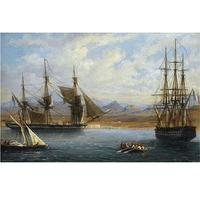
Piraeus
Hubert Sattler
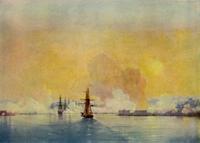
Arrival into Sevastopol Bay
Ivan Aivazovsky
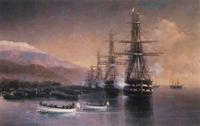
The landing to Subashi
Ivan Aivazovsky
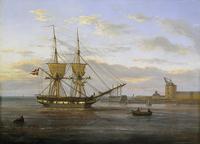
Entrance to the Port of Copenhagen
Johan Christian Dahl
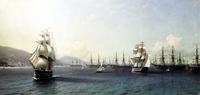
The Black Sea Fleet in Feodosia Bay before the Crimean War
Ivan Aivazovsky
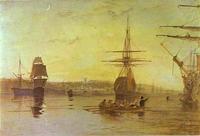
Cowes, Isle of Wight
J.M.W. Turner
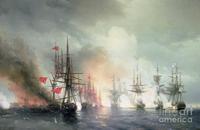
Russian-Turkish Sea Battle of Sinop on 18th November 1853
Ivan Aivazovsky
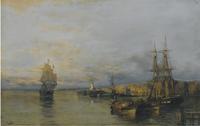
Along the coast
Konstantinos Volanakis
Sunset at the seashore
Konstantinos Volanakis
A squadron of the Black Sea Fleet before going on a raid on Sevastopol
Ivan Aivazovsky
Sevastopol
Ivan Aivazovsky
The battle of fregate Flora against Turkish steamships near Pitsunda November, 11 1853
Alexey Bogolyubov
Trouville
Eugene Boudin
Sunrise Over Nantucket
John Stobart
The morning catch
Konstantinos Volanakis
The Battle of Navarino
Ivan Aivazovsky
Turkish steamships attack 44 gun fregate Flora
Alexey Bogolyubov