
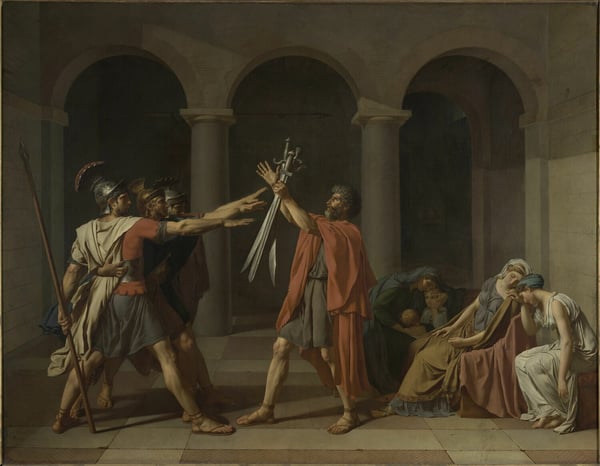
Expert analysis of Jacques-Louis David’s The Oath of Horatii
Style: Neoclassicism · Genre: history painting
Expert Analysis: "The Oath of Horatii" by Jacques-Louis David
As a defining masterpiece of Neoclassicism, Jacques-Louis David’s The Oath of Horatii (1784) stands as a paradigm of moral clarity, civic virtue, and formal rigor. Executed in the history painting genre—then considered the highest artistic calling—the work draws on a legendary episode from ancient Rome to embody Enlightenment ideals of duty over personal emotion.
Composition and Style
The painting is structured with geometric precision: three distinct groups are arranged within a shallow, stage-like space framed by a severe Doric arcade. On the left, the three Horatii brothers extend their arms toward their father, who holds up three swords. Their taut, muscular forms and rigid silhouettes echo the clean lines of classical sculpture. On the right, the women—including the sister of the Horatii, Camilla, and the betrothed of one brother—sink into passive, curvilinear despair, their soft forms contrasting with the brothers’ stoic resolve. The chiaroscuro is stark, with cool, restrained colors (grays, browns, muted reds) that avoid decorative excess, focusing attention on the solemn narrative.
Significance within Neoclassicism
David’s painting embodies the Neoclassical rejection of Rococo frivolity in favor of archaeological accuracy, moral instruction, and a return to the “noble simplicity and calm grandeur” of antiquity (as defined by Johann Joachim Winckelmann). The subject—a Roman legend wherein three brothers swear to fight for Rome, knowing only one will survive—was chosen to inspire patriotism and self-sacrifice. The rigid, frieze-like composition and the use of a single light source reinforce the gravity of the oath.
Historical and Political Impact
Completed four years before the French Revolution, The Oath of Horatii became an unofficial rallying cry for revolutionary ideals. Its stark, unadorned style and emphasis on loyalty to the state over family ties resonated deeply in pre-revolutionary France. The painting’s psychological tension—the brothers’ rigid commitment versus the women’s grief—underscores the conflict between public duty and private feeling, a central theme of Enlightenment civic humanism.
Legacy
David’s work permanently redefined history painting: it proved that a modern artist could rival antiquity in moral seriousness and compositional clarity. The painting’s influence extended across Europe, shaping the visual language of state propaganda and heroic narrative for generations. The Oath of Horatii remains the quintessential Neoclassical statement—a frozen moment of collective will that continues to epitomize art’s power to embody political and ethical ideals.
Museum / Gallery
Visually similar
20 works with related composition and palette
Wamba Renunciando a La Corona
Juan Antonio Ribera
The Death of Brutus
Pierre-Narcisse Guerin
The Death of Lucretia
Gavin Hamilton
Cleombrotus Ordered into Banishment by Leonidas II, King of Sparta
Benjamin West
Belisarius Begging for Alms
Jacques-Louis David
Marcus Aurelius Distributing Bread to the People
Joseph-Marie Vien
MORT DE LUCRECE
Jacques Réattu
The Death of Arthur
William Hamilton

Saint Paul Bitten by a Viper
Cornelis Troost
Priam Pleading with Achilles for the Body of Hector
Gavin Hamilton
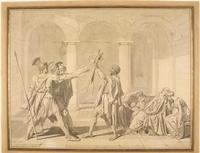
The Oath of the Horatii, according to David
Jean Auguste Dominique Ingres
The Death of Germanicus
Nicolas Poussin
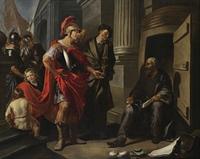
Alexander The Great And Diogenes
Hendrik Heerschop
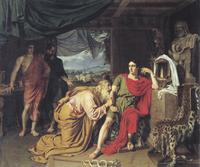
Priam Begging Achilles for Hector's Body
Alexander Ivanov
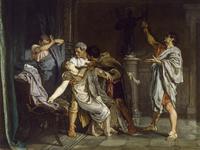
The Death of Lucretia
Eduardo Rosales
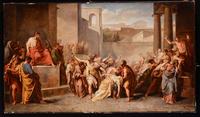
The death of Virginia
Vincenzo Camuccini
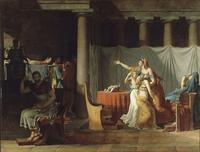
Lictors Bearing to Brutus the Bodies of his Sons
Jacques-Louis David
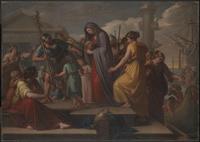
Agrippina Landing at Brindisium with the Ashes of Germanicus
Gavin Hamilton
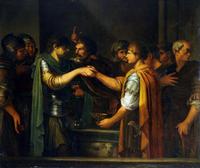
The Oath of Catiline
Joseph-Marie Vien
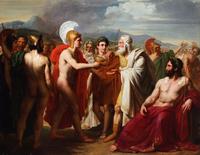
Achilles
Charles-Philippe Lariviere