Expert analysis of Anthony van Dyck’s Charles I on horseback
Style: Baroque · Genre: portrait
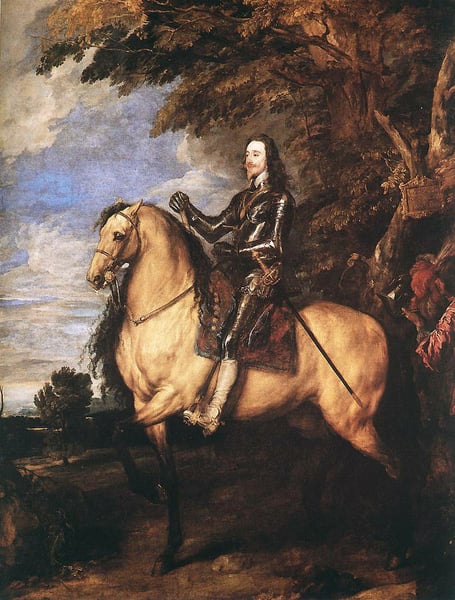
Anthony van Dyck's "Charles I on horseback" (c. 1637–38) is a seminal work of Baroque portraiture that redefined the royal equestrian portrait in European art. Painted as the centerpiece of van Dyck's series of portraits for the English court, this work masterfully blends the grandeur of state ceremony with the intimate immediacy characteristic of van Dyck's style.
Significance within the Baroque period:
-
Dynamic composition and naturalistic authority: Unlike earlier, rigid equestrian portraits (e.g., Titian's Charles V at Mühlberg), van Dyck presents the king in a moment of poised movement. The horse is caught mid-stride, its curving neck and raised foreleg echoing the Baroque fascination with energy and motion. Charles I sits with relaxed elegance, his glance direct yet serene—a fusion of divine right and human grace that defines the Baroque ideal of monarchy.
-
Van Dyck's signature handling of color and light: The silvery-gray horse contrasts with the deep crimson sash and the king's polished armor, while the stormy sky and lush landscape—painted in a broad, atmospheric manner—create a dramatic backdrop. The light falls selectively on the king's face and the horse's chest, drawing the viewer's eye to the symbols of power: the baton of command, the Order of the Garter, and the king's confident posture.
-
Symbolic and stylistic innovations: Van Dyck omits allegorical figures or overt classical references, focusing instead on the natural nobility of the sitter. The large oak tree on the left anchors the composition and alludes to the strength of the Stuart dynasty. This direct, psychologically penetrating approach—combined with the monumentality of the equestrian format—influenced later court painters from Velázquez to Gainsborough.
-
Historical impact: This portrait became the defining image of Charles I, immortalizing his "cavalier" persona and the refined aesthetic of the Caroline court. It set a new standard for royal portraiture across Europe, where the ruler was no longer a distant icon but a charismatic, accessible figure of power.
In summary, "Charles I on horseback" is a triumph of Baroque portraiture because it marries dynamic realism with sophisticated symbolism, capturing both the political authority and the personal allure of its subject—a balance van Dyck achieved with unparalleled finesse.
Museum / Gallery
Visually similar
20 works with related composition and palette
Philip Ii on Horseback
Peter Paul Rubens
Equestrian Portrait of Charles I, King of England
Anthony van Dyck
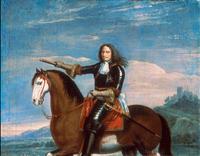
Equestrian Portrait of Henri De La Tour D'auvergne, Vicomte De Turenne
Adam van der Meulen
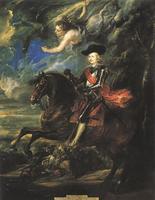
The Cardinal Infante
Peter Paul Rubens
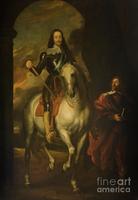
Charles I On Horseback
Anthony van Dyck
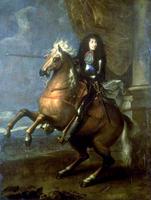
Louis XIV, Equestrian Portrait
Charles Le Brun
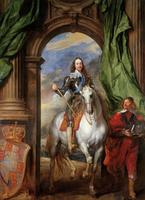
Equestrian Portrait of Charles I, King of England with Seignior de St Antoine
Anthony van Dyck
Allegorical Portrait of Philip IV
Diego Velazquez
Emperor Charles V on Horseback
Anthony van Dyck
Equestrian Portrait of Giancarlo Doria
Peter Paul Rubens
Equestrian Portrait of Philip IV
Diego Velazquez
Louis XIV, Equestrian Portrait
Charles Le Brun
Equestrian Portrait of Louis Xiv of France
Adam van der Meulen
Charles II, King of Spain, on Horseback
Luca Giordano
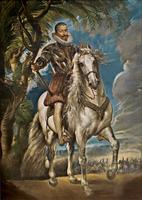
Equestrian Portrait of the Duke of Lerma
Peter Paul Rubens
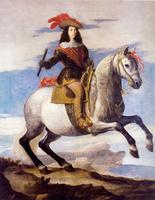
John of Austria the Younger
Jusepe de Ribera
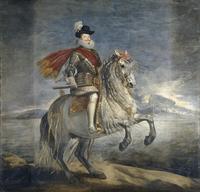
Equestrian Portrait of Philip III
Diego Velazquez
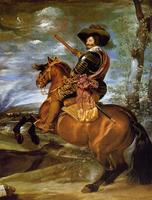
Equestrian Portrait of Don Gaspar de GuzmanCount Duke of Olivares
Diego Velazquez
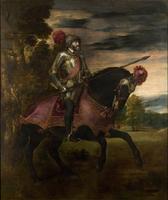
Emperor Charles V at Muhlberg
Titian
King Charles II and Jane Lane Riding to Bristol
Isaac Fuller