
Expertenanalyse zu Lucas Cranach the Elders The Judgement of Paris
Stil: Northern Renaissance · Genre: mythological painting
Expert Analysis of "The Judgement of Paris" by Lucas Cranach the Elder
As a masterpiece of the Northern Renaissance and a prime example of mythological painting, Cranach's interpretation of the classical tale stands out for its distinctly Northern European sensibility. Unlike Italian Renaissance treatments that emphasize idealized classical proportions and heroic nudity, Cranach infuses the scene with a courtly, almost mannerist elegance that was highly prized in German princely courts.
Significance within the Northern Renaissance:
-
Synthesis of Classical and Courtly Traditions – Cranach reimagines the Greek myth through a Northern lens. The three goddesses (Hera, Athena, and Aphrodite) are depicted not as monumental, statuesque figures but as slender, elongated, and gracefully posed women with small high breasts, narrow waists, and flowing hair—a signature Cranach ideal. This reflects the Northern Renaissance’s tendency to merge classical subject matter with local aristocratic tastes for delicate, decorative beauty.
-
Symbolic and Erotic Nuance – The painting is notable for its understated eroticism, typical of Cranach’s mythological works. The goddesses are shown nude, yet their poses are demure and refined, often holding thin transparent veils. Paris, dressed in contemporary courtly armor, embodies the chivalric knight, bridging the ancient story with the values of 16th-century German nobility. This juxtaposition makes the work a moralizing allegory about desire, judgment, and vanity—themes resonant with the Reformation-era humanist culture of Cranach’s patrons.
-
Rich Atmospheric Landscape – The background features a characteristic Northern Renaissance landscape: a deep, forested vista with a distant castle, rocky outcrops, and a luminous sky. This setting is not merely decorative but frames the mythological scene within a recognizable Germanic world, grounding the exotic narrative in a familiar, tangible environment.
-
Workshop Innovations and Popularity – Cranach produced multiple versions of The Judgement of Paris (c. 1520s–1530s), often with slight variations in the figures’ poses and accessories. This repetition was not a weakness but a testament to the composition’s commercial and cultural success. It demonstrates how mythological painting in the North became a vehicle for showcasing stylistic trademarks—the “Cranach type” of slender female nudes—which influenced subsequent German and Flemish artists.
In summary, this artwork is significant because it redefines a canonical classical story through the distinctive formal language of the Northern Renaissance: courtly elegance, symbolic eroticism, and a vivid, naturalistic setting. It highlights Cranach’s role as a bridge between the medieval Gothic tradition and the humanist revival of antiquity, making it a key work in understanding the spread and adaptation of mythological themes north of the Alps.
Museum / Gallery
Visuell ähnlich
20 Werke mit ähnlicher Komposition und Farbpalette

The Judgment of Paris
Lucas Cranach the Elder

The Judgment of Paris
Lucas Cranach the Elder

The Judgment of Paris
Lucas Cranach the Elder

The Judgment of Paris
Lucas Cranach the Elder

The Judgement of Paris
Lucas Cranach the Elder
Cupid complaining to Venus.
Lucas Cranach the Elder

Altarpiece with The Martyrdom of St. Sebastian
Hans Baldung

Venus and Cupid
Lucas Cranach the Elder

The Silver Age
Lucas Cranach the Elder
Three Ages of Man and Three Graces
Hans Baldung
Harmony or The Three Graces
Hans Baldung
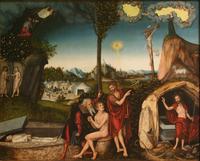
Law and Grace
Lucas Cranach the Elder

The Golden Age
Lucas Cranach the Elder

Adam and Eve in the Garden of Eden
Lucas Cranach the Elder
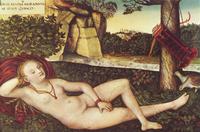
Reclining Diana
Lucas Cranach the Elder

The Fall of Man
Hugo van der Goes

The Golden Age
Lucas Cranach the Elder

Diana and Actaeon
Lucas Cranach the Elder

The Seven Ages Of Woman
Hans Baldung
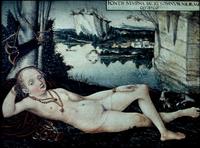
Water Nymph Resting
Lucas Cranach the Elder